

Hi, I’m Garrett Jestice. I help maxed-out fractionals and consultants turn custom client work into one repeatable offer and grow their businesses, and I write about how here every Tuesday. I also run 10x Solo, a private community where solo fractionals, consultants, and micro-agency owners compare notes on what’s working to grow their businesses.
Picture the end of a strategy session with a client. The numbers are clear: if they want to hit their growth target, they need to charge more. You discuss what the plan is, and the client decides that prices need to go up 30%, starting immediately. Mike on their team is tasked with updating the website this week.
Six months later, you check in. The website still shows the old prices. They started second-guessing it and wanted to do a little more testing first. The decision they made in that session never turned into action.
Joe Daniels opened his 10x Solo workshop last week with that scene, because he’s watched it play out with clients for years. Joe has spent most of his career helping founders make the big calls on positioning, offers, pricing, hiring, firing, and processes. He started as the first hire at an agency, where much of his job was being the founder’s sounding board. Today he runs The Decision Gym, where he trains people to make decisions quicker and more confidently.
His name for that six-month stall is the decision-action gap. (The research term is the intention-action gap.) It’s the space between deciding and doing, and Joe says it’s where most decisions go to die.
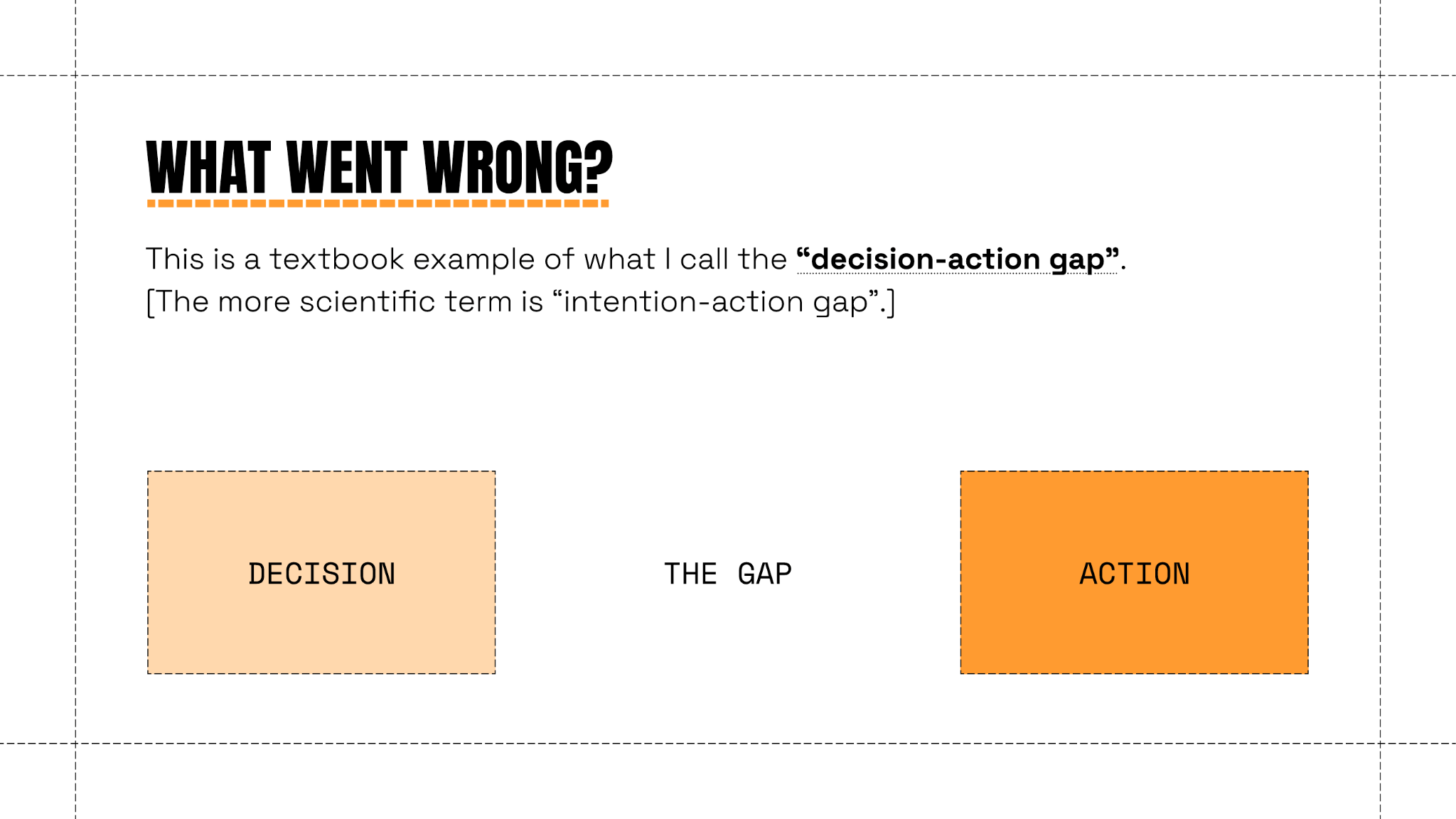
As solos, we can easily fall into the same gap with our own decisions. (I know that one from experience.) With no business partner or team to hold us to a decision, it can sit in the gap for months.
Big decisions usually stall because of a worst-case scenario you can’t stop thinking about. Doomcasting is Joe’s process for putting that scenario on paper so you can finally act.
Three reasons big decisions stall after you make them
Joe says the decisions that get stuck in the decision-action gap usually have three things in common.
They’re hard to reverse. If you need to undo them, it could do some damage.
They have no single right answer. A price increase could be 10%, 30%, or 50%. Nothing tells you which one was correct.
The consequences are big. If you raise prices, you might lose every client.
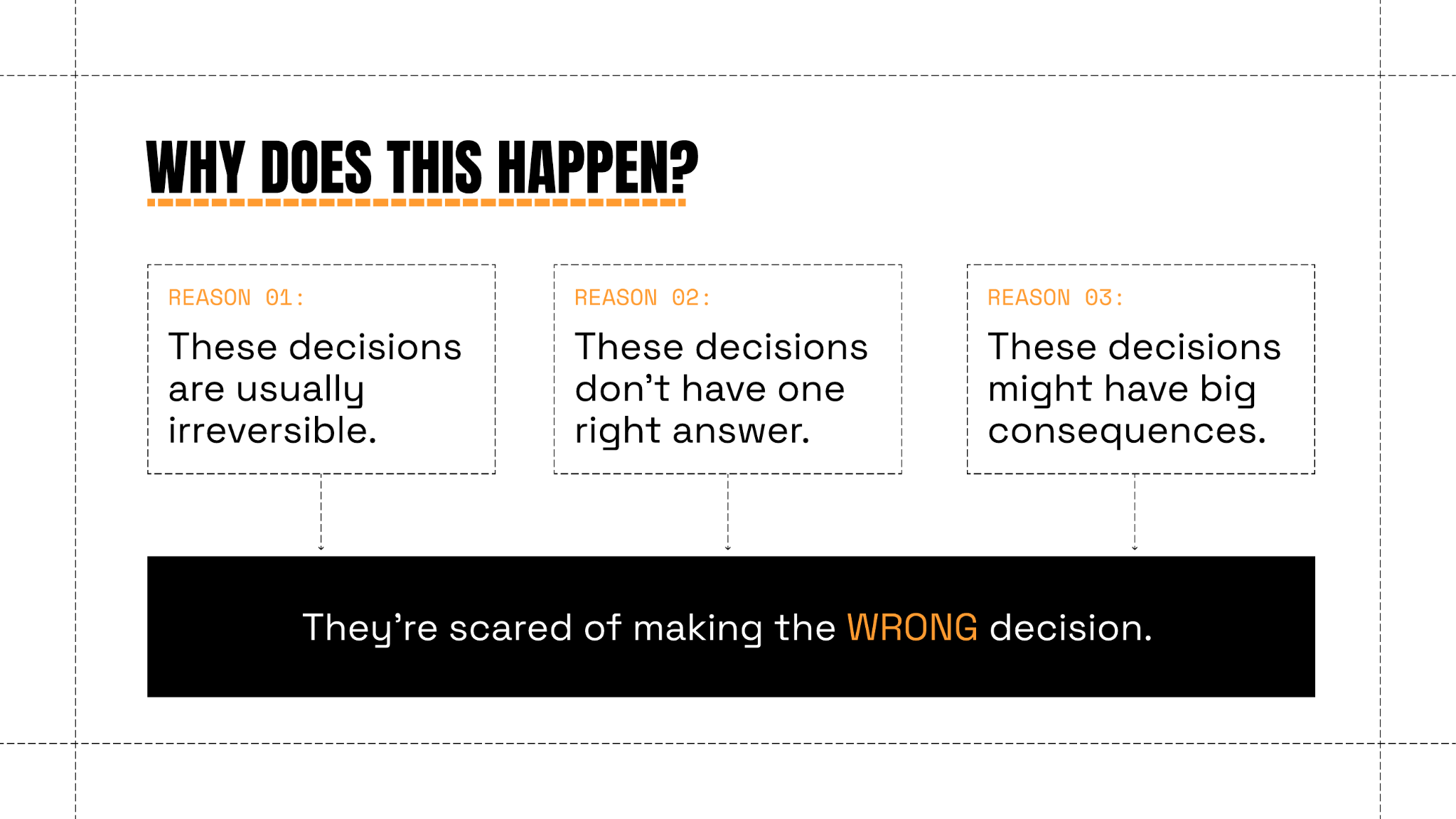
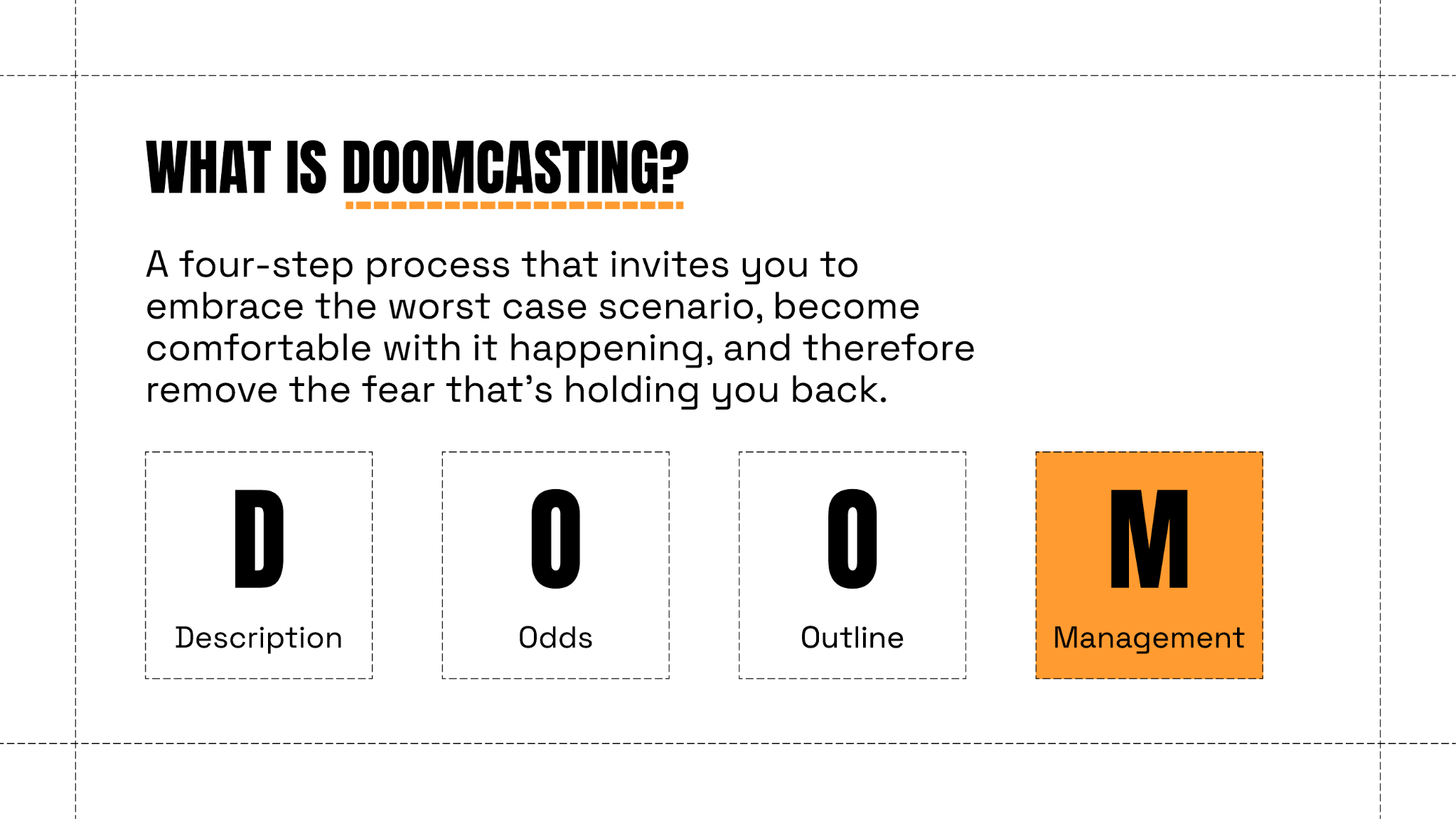
Put those together and it’s easy to fear making the wrong call. Joe’s fix for that fear borrows from therapy. Therapists use a technique called decatastrophizing, where you face the worst-case scenario head on instead of avoiding it. Joe wove in other pieces of decision science, turned it into a four-step process for business decisions, and called it doomcasting. (He admits the name has unfortunate SEO timing, thanks to the upcoming Avengers movie.)
The four steps in Joe’s process spell DOOM.
D: Describe the worst case
Write out the worst-case scenario in concrete detail. What could happen, who gets hit, and over what timeline.
Say you’re raising your own prices by 30%. The worst case might look like this: Every client leaves within a few months. Revenue drops hard, and you scramble to replace them. You have to let contractors go. Longer term, the business could collapse.
Why spell it out in detail? Research shows a vague fear paralyzes people more than a detailed picture of the thing they’re afraid of. Joe compared it to a horror movie. The monster is scariest while it’s lurking in the shadows. Once you see it, it’s usually not as scary anymore.
O: Assign the odds
You’ve already described the worst case. Now map out the other realistic outcomes alongside it and give each one a rough probability. It won’t be exact. It’s your best estimate from what you know.
Joe’s simplified version for the 30% increase looked like this:
20%: Every client pays the new price, new clients join at that price too, and you wish you’d done it sooner.
45%: 20% to 30% of clients leave and new business feels a bit harder, but the ship steadies.
30%: 50% to 70% of clients leave and new business is much harder. You’re in survival mode, but you probably get through it.
5%: Every client leaves, new business feels impossible, and the business may end.
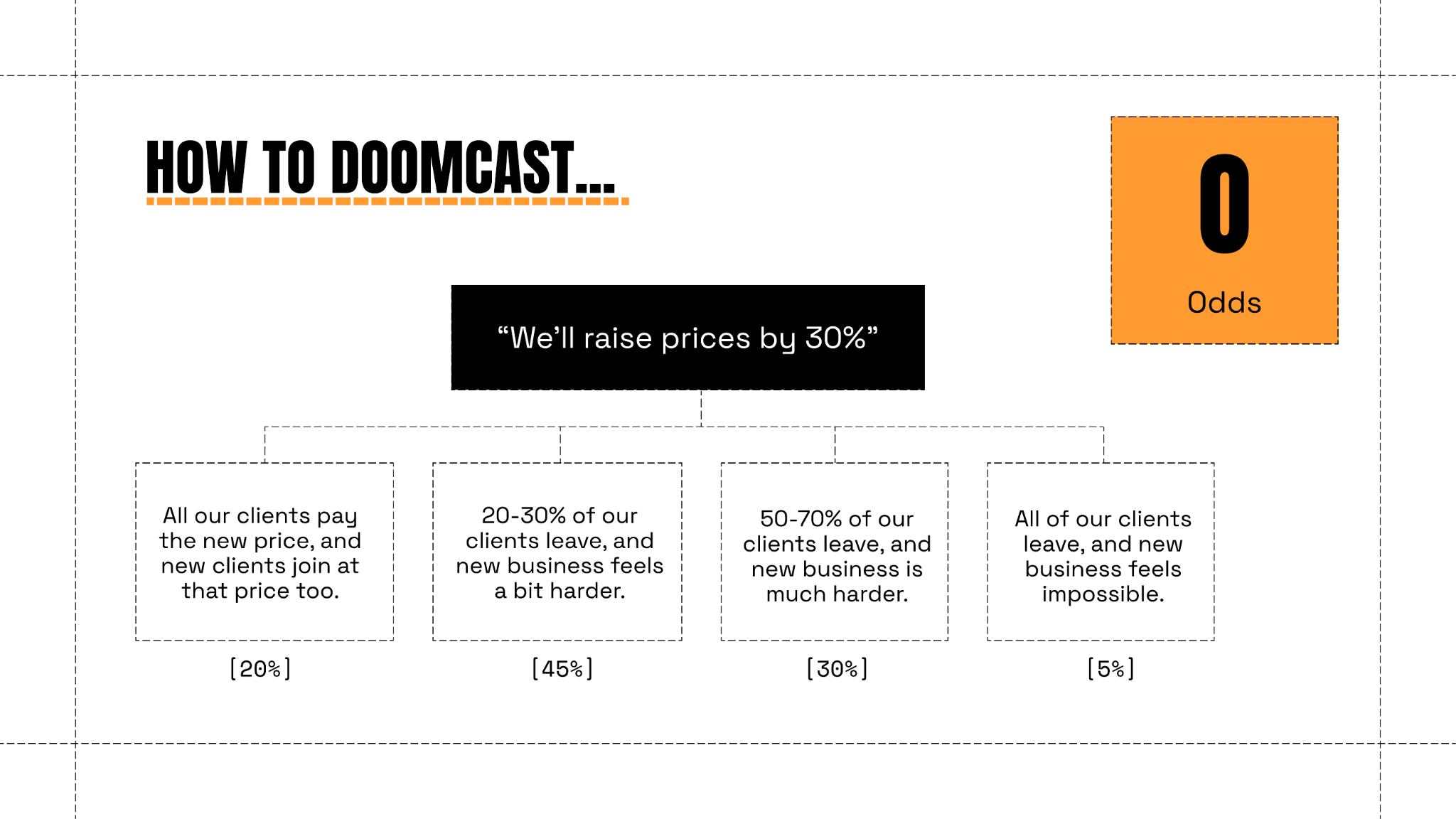
The fear holding you back and preventing you from taking action is only 5% likely. Once you see that number on paper, it’s a lot harder to justify letting it make the decision for you.
Joe was clear that the odds can point the other way, though. You might look at that 5% and decide that probability is too high for you. That’s fine. Choosing not to act is still a decision. The goal is to make that call based on the real odds, not the fear.
O: Outline how it would happen
Start from the worst-case scenario and work backward. This is a pre-mortem.
Why would every client leave? Maybe they shopped around and found someone cheaper doing the same thing. Why would they shop around? Maybe the sudden jump annoyed them.
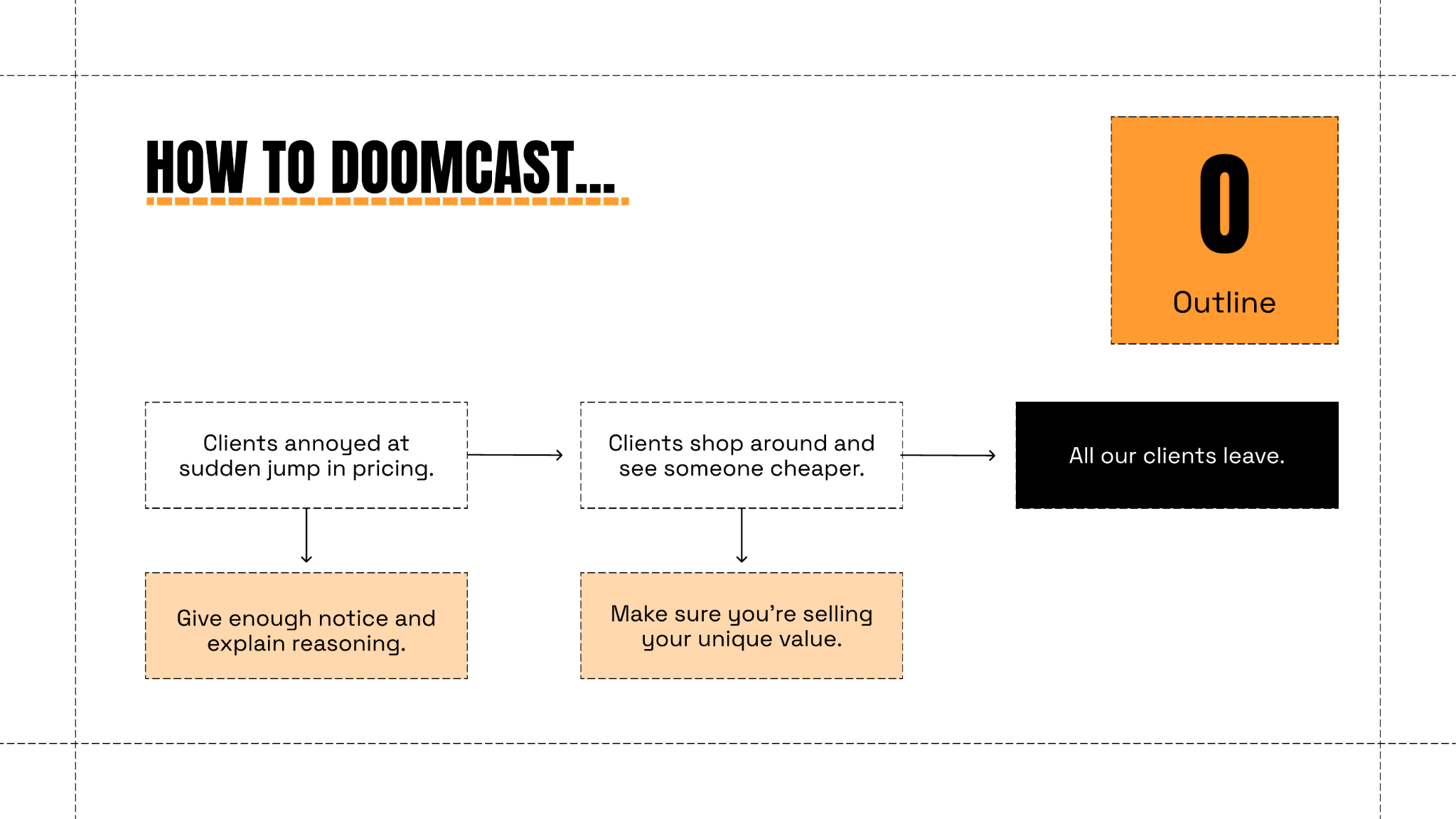
Each link in that chain is a risk you can get ahead of. If you’re worried the price increase will annoy people, give plenty of notice, explain your reasoning, or grandfather current clients at the old price. If you’re worried they’ll find someone cheaper, sharpen your positioning so the comparison doesn’t hold up.
It’s easy to assume the outcome is out of your hands. But the steps you take after a decision have a big impact on whether clients stay or go.
M: Manage it
Look at your worst-case scenario, your odds, and your prevention plan next to each other, and then ask yourself three questions:
Is the worst-case scenario likely?
If it happened, could you survive it?
Can you lower the odds or soften the blow?
Joe frames this as felt risk versus actual risk. Felt risk is how the decision feels before you run the steps. Actual risk is the risk that’s left once you’ve run the odds and made a plan to prevent the worst-case scenario. When there’s a big difference between the two, it’s usually easier to commit. When the actual risk turns out to be bigger than you thought, you can confidently decide not to act. That’s a good outcome too.
Doomcasting as a solo
Doomcasting works on your own, but it works better with someone to pressure-test your odds and your worst-case scenario. Joe said that’s probably why businesses with co-founders often make decisions faster. An outside person with no direct stake in the outcome (like a peer or coach) is even better than a co-founder.
AI can play that role too if you’ve set it up with your context and your process. My own version lives in Claude. My chief of staff setup keeps a log of the decisions I make for my business and each client, so when I ask why we’re doing something a certain way, it pulls up the decision behind it. It also shows me when I’ve changed my mind.
Putting it all together
Block 20 minutes this week and do the following:
Pick one big decision you’ve already made but haven’t acted on.
Describe the worst-case scenario in concrete detail.
List the realistic outcomes and give each a rough percentage.
Work backward from the worst case to list what would cause it, then write one way to prevent each cause.
Compare the felt risk to the actual risk, then decide whether to move forward or let it go. If you move forward, set a date to complete the first step.
Run the doomcast so your decision doesn’t end up like that client’s price increase, still stuck in the gap six months later.
Keep building,
Garrett
Just for 10x Solo members:
Last Thursday’s workshop: The recording of Joe’s session, his full slides, and a 25-minute audio summary are all in the Notion library. Members also get 20% off his four-week decision cohort. A few seats are open in November and December.
This Thursday: I’m running this one, on the 10 P’s I use with clients to outline an offer. A lot of what gets called a marketing or positioning problem is really an offer problem underneath. You’ll leave with the full template to fill in for your own. 10am MT / 12pm ET, already on your calendar.
In #asks-and-answers: A member who has spent years on positioning, messaging, and website projects says 75% of her inbound this year has been for LinkedIn content instead. She’s asking how much of the old work to keep and how much to follow the market. 10 replies
P.S. When you’re ready, here are two ways I can help you:
Join the 10x Solo community. A private community of full-time B2B solos, fractionals, and small agency owners. Weekly workshops, honest peer feedback, and referrals. Apply here.
Work with me 1:1. For maxed-out consultants, fractionals, and agency owners who want to make more money in less time by designing a more repeatable offer that you love delivering. DM me to set up a time to chat.
Have questions or comments about today’s topic? Share them below.
The 30% price rise is the cleanest example of the gap because the decision was real and the first action was still vague. "Update the website" is where it went to die; "change the three numbers on the services page by Friday" survives. Every stalled decision I have watched had a first step too big to start. Shrinking the first step until it fits one afternoon does more than another round of conviction.
"no business partner or team to hold us to a decision" is the part that hit. i'm solo, so nobody notices when something i decided just quietly doesn't happen. funny thing is i already do this kind of pre-mortem for client systems, what breaks and who catches it when i'm not there. i've just never pointed it at my own business decisions.