

Hey friends,
Most solos never asked themselves whether they’re running the right business model. They took the first work that came, priced it at what felt reasonable, and three years later the business is stuck at a ceiling they can’t name.
This guide is built to answer one question: am I running the right model, and if not, what should I be running instead?
It’s a rebuild of the post I published in April. More research turned up gaps, so this version has seven models instead of six, what your choice locks in downstream, how to grow revenue inside the model you’re in, and when to switch instead of pushing harder.
It’s long on purpose. Treat it as a reference. Skim the list, use the profiles to eliminate what doesn’t fit, come back for the rest when you need it. I hope it’s helpful.
– Garrett
What Is a Business Model?
Your business model is the structural pattern of how you create, deliver, and capture value. Four questions define it:
1. What are you selling?
Execution, advice, a program, a peer network, or an asset you built once.
2. Who receives the value?
One client, a small group, many people at once, or anyone with access.
3. Who does the work?
You personally, your team, or the client themselves.
4. How do you capture value?
Retainer, project, subscription, per-seat, or license: the model determines which formats are viable.
The 7 Primary Business Models for Solos
There are seven primary models for most B2B solos and agency owners. Each has variants or different forms of the same underlying approach that differ in delivery intensity, client count, or pricing format.
1. Embedded Operator: You go inside a company and own a seat or function. You’re accountable for a department, initiative, or executive role. Variants include:
Fractional (part-time, 2–4 clients concurrent)
Interim (full-time, 1 client, defined end date)
2. Consultant: Hired for your expertise: either on ongoing call for strategic questions (Retainer) or to solve a defined problem and deliver an outcome (Project). Either way, you don’t own the function. Variants include:
Retainer (ongoing access)
Project (fixed scope)
3. Advisor: Paid for your judgment. You influence decisions; you don’t implement them. Zero execution, zero deliverables. Pure perspective and access. Variants include:
CEO sounding board
Board seat
4. Coach: You develop the person or team’s capability through a structured process. You’re not solving it for them. You’re building their ability to solve it themselves. Variants include:
Coach (1:1)
Coach (Group)
5. Agency: Team-delivered execution. You sell and direct; your team does the work. The lever is headcount: you stop personally delivering in order to serve more clients than your hours allow. Variants include:
Micro (contractor-based, founder close to work, standardized service, 5–15 clients)
Traditional (FTE team, founder as CEO, removed from delivery)
6. Community / Membership: You curate and facilitate a peer network where members create most of the value for each other. You host the container and set the culture. Recurring access model: you architect the room; the members fill it. Variants include:
Small group mastermind (peer-led, 6–12 people)
Peer community or membership (larger, access-based, peer value flows without your direct facilitation)
7. Product: You build something once and sell access to it indefinitely. Delivery is fully asynchronous: buyers access the value on their own time, without you in the room. The only primary model where delivery requires no presence after it’s built. Variants include:
On-demand course
Digital product (ebook, template, toolkit)
IP/Licensing (methodology, certification, train-the-trainer)
In addition, the following are revenue streams many solos layer on top of their primary model: speaking, paid sponsorships, staffing and placement, deal brokering, and content or media (newsletter, podcast, video). For example, a consultant who does paid keynotes is still running a Consultant model with a speaking revenue stream. They can eventually become a primary model, but that’s rare for most B2B solos.
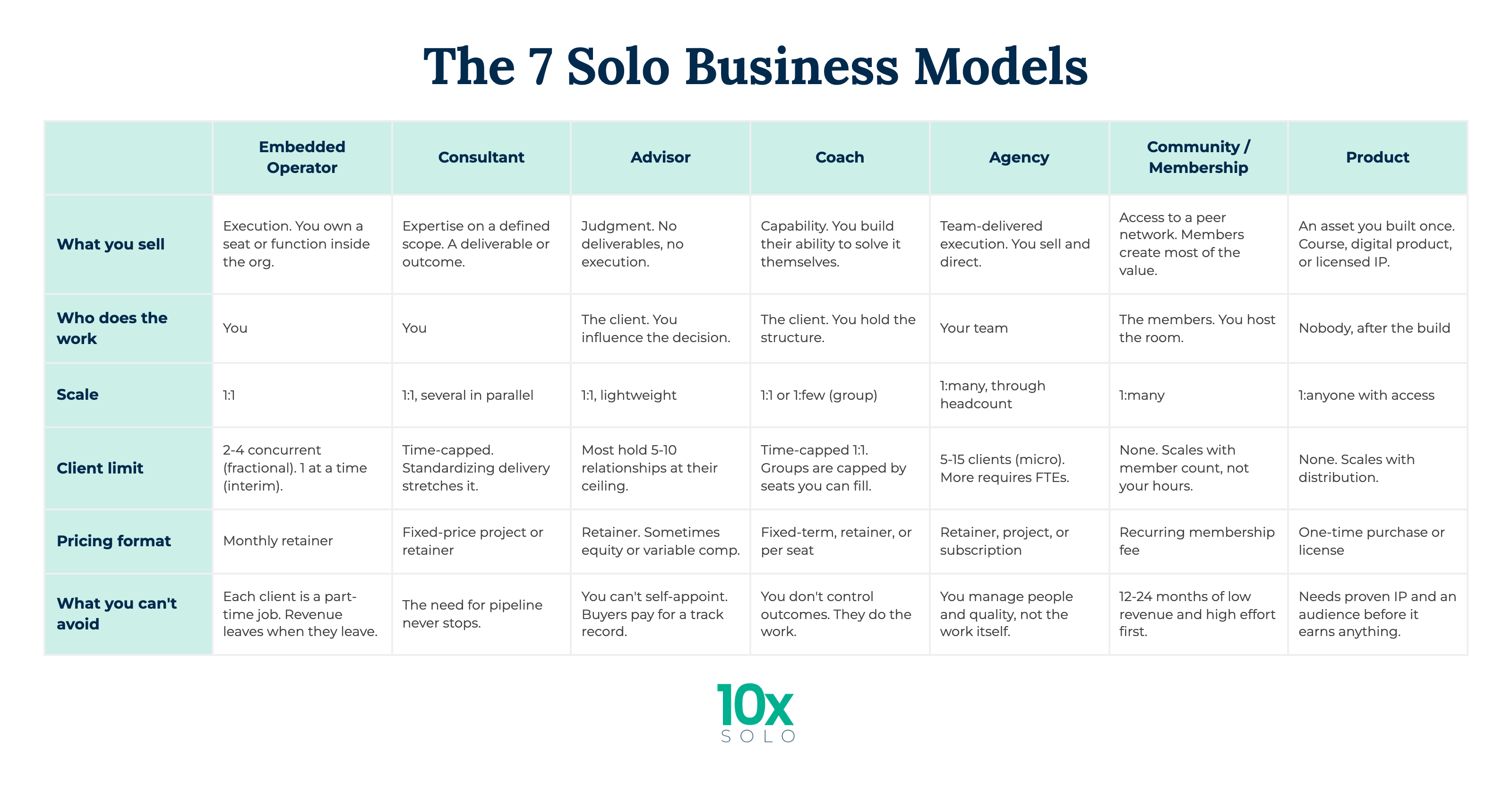
What Your Model Choice Influences
Your model is a structural commitment with downstream consequences that influences the following factors:
Work type: What you’re actually doing with clients: executing, advising, developing capability, facilitating peer connection, or licensing an asset
Scale: How many clients or people receive your value at once (1:1, 1:few, 1:many, 1:∞)
Client limit: The point at which adding another client degrades delivery capacity: fewer for time-based models (2–4 for Embedded Operator), nonexistent for Product and Community
Revenue ceiling: The dollar ceiling before the model requires a structural change: rate × max clients for time-based models; scales with distribution rather than hours for Product and Community
Price structure: Which pricing formats are viable: retainer, project, subscription, per-seat, per hour, license, and which are optimal for the work
Outcome ownership: Whether you own the result (Consultant, Embedded Operator), guide without owning it (Coach), or influence without owning it (Advisor)
Team: Whether solo is structurally viable or the model requires managing others in some capacity
Demand volume: How many new clients or deals the model requires per year: a fractional usually needs 1–2 new clients a year to replace churn at 2–4 concurrent; a project consultant might need 6–8 new deals a year; a cohort coach might need to fill seats 2–4 times a year
What your model doesn’t determine: the problem you solve, your area of expertise, your ICP, or your rates. Those usually stay the same as you shift between models or even inform which models are available to you in the first place.
How to Grow Revenue Within Your Model
There are only three ways to grow revenue within your current business model:
1. Monetization (increase what each client pays)
Lever 1: Increase prices. Move upmarket, re-price to outcomes instead of hours, or remove lower tiers.
Lever 2: Sell more to each client. Expand scope, add days, or introduce a premium tier within existing relationships.
2. Retention (keep clients longer)
Lever 1: Decrease churn. Document results throughout so the value is clear before renewal; run proactive renewal conversations, not deadline ones.
Lever 2: Extend engagement length. Structure new engagements for longer initial terms where possible.
3. Acquisition (increase the number of clients or buyers)
Lever 1: Grow your top of funnel. Build distribution through content, referrals, and community so inbound fills capacity with less outbound.
Lever 2: Increase conversion rates. Sharpen targeting to reduce wrong-fit conversations and shorten sales cycles.
The biggest constraint solo businesses face is delivery capacity. As a result, not all six levers are available all the time. Which you can pull depends on where your capacity is at.
At max delivery capacity:
Focus on Monetization and Retention. Increase prices, expand scope with existing clients, and keep the ones you have through proactive renewal conversations and documented results. Acquisition levers can run in the background: build pipeline through content and referrals for when capacity opens. But don’t push to close clients you can’t serve well.
To add delivery capacity:
The only within-model path is to standardize delivery through repeatable offers, processes, templates, and better tools. This reduces hours per engagement and creates room for more. But it’s finite. When it’s maxed, switching models is the only other path.
With more delivery capacity:
Now all six levers are open. Usually, you should prioritize in order: Monetization and Retention first, then Acquisition (add new clients to fill the capacity you’ve created).
At the hard capacity ceiling, switch models:
When you’ve maxed what the model can do, additional revenue growth requires a structural change. Each option comes with tradeoffs:
Coach (Group) or Community: serve more people at once, but shift from individual relationships to group dynamics
Product: remove yourself from delivery entirely, but trade ongoing 1:1 client relationships for broader distribution
Agency: serve more clients than your personal hours allow, but you’re now managing a team and projects, not doing the work
Model Profiles
In real life, solo businesses usually blend models. A fractional CMO who trains the internal team is running Embedded Operator with a coaching layer on top. A consultant who builds a course has added a Product layer.
The profiles in this guide describe the dominant structures. The “Natural path forward” sections point to both model switches and layers you can add without leaving your primary model.
Two inputs should help you filter the options below:
Your Business Lighthouse gives you the capacity math including revenue goal and hours-per-week target. If a model can’t reach your goal at your target hours, with your current ICP, it shouldn’t be on the list.
Your Unique Ability tells you the personal fit. This is the work that both energizes you and that others recognize as your best. A model built on work that drains you, even if you’re excellent at it, is a business you’ll burn out on.
Think through both filters before reading the profiles below.
1. Embedded Operator
What it is:
You go inside a company and own a seat or function. You’re accountable for outcomes, not just advice. You’re in their systems, their meetings, and their org chart at least part-time.
Variants:
Fractional: Part-time. Typically 1–2 days per week per client. Concurrent clients: 2–4.
Interim: Full-time. One client at a time. Defined end date and succession plan built in from day one.
A day in the life:
You’re in their Slack. You get pulled into a thread about a campaign that’s underperforming. You join a 30-minute standup. You review a draft deliverable from their internal team and give notes. This is your client’s org, and you’re running a piece of it.
Who fits:
Deep operational expertise in a specific function (marketing, sales, ops, finance, product)
Strong preference for being close to the work and seeing things through
Comfortable with ongoing accountability for results
Wants stable, predictable monthly retainer income
Typically senior or director+ level in the function; engagements usually run 6+ months
Tradeoffs:
You trade freedom for stability; each client feels like a part-time job
Adding a client is genuinely more work; if one exits, you feel it immediately in revenue
Balancing multiple clients can be very difficult because each wants all your time; boundary setting is crucial
Offer that doesn’t fit:
“I’ll give you a 30-minute monthly strategy call” (that’s Advisor, not Embedded Operator)
Natural path forward:
Advisor: reduce execution load while maintaining client relationships
Consultant: move from ongoing embedding to defined-scope projects
Agency: add a team to serve more clients
How to increase revenue:
Increase prices: specialize the function or industry, move upmarket, or re-anchor on bigger outcomes at the next renewal
Expand scope: more days/month per existing client before adding a new seat
Keep clients longer: a 12-month engagement vs. 6 months doubles revenue without new sales
Add clients: only after trying to expand scope or capacity (each new client adds additional coordination load)
2. Consultant
What it is:
Hired for your expertise on a defined scope. You apply your knowledge, produce a work product or outcome, and either exit (Project) or stay engaged on a recurring basis (Retainer). Either way, you don’t own the function. You’re a specialist brought in for the problem, not a permanent part of the org.
Variants:
Retainer: Ongoing access to your expertise for a defined monthly fee. Relationship-based, lower intensity per month.
Project: Fixed scope, fixed deliverable, fixed price. Clear start and end. A Sprint is a compressed, high-intensity variant: same structure, faster timeline.
A day in the life:
You’re working on a deliverable for a client you’ll exit in 6 weeks. You’re not in their Slack all day: you have dedicated working time. You have an output to produce by the end of the week. You’re solving a specific problem with a clear definition of done.
Who fits:
Deep expertise in a specific discipline that translates into clear work products
Prefers defined scope and clear deliverables over open-ended embedding in a client’s org
Wants flexibility to work with multiple clients in parallel
Comfortable with the project cycle (win it, do it, done, repeat), including the intense push before a deliverable is due and the quieter stretches in between
Tradeoffs:
Project model: stability traded for the freedom of defined endings
Retainer model: recurring revenue without the operational accountability of an Embedded Operator
Either way, if your pipeline dries up, you feel it fast
Juggling multiple clients means each one thinks they have priority; scope boundaries are an ongoing part of the job
Offer that doesn’t fit:
“I’ll run your marketing department” (that’s Embedded Operator)
Natural path forward:
Advisor: strip out the execution, sell the perspective
Product: codify the methodology into a course or licensed framework
Coach (Group): run the same process with multiple clients simultaneously
Embedded Operator: a project that goes well often becomes the foundation for ongoing fractional work
How to increase revenue:
Increase prices: specialize tighter, move upmarket, or re-price to an outcome instead of hours on the next project
Standardize delivery: same revenue, fewer hours per engagement
Re-engage past clients: they skip the sales cycle entirely
Build distribution: faster pipeline fill is the fix for dead time between projects
3. Advisor
What it is:
Paid for your judgment on business decisions related to your area of expertise. You help the client make better choices about the company’s direction, strategy, and problems. No deliverables, no execution. Pure perspective and access.
The value stays with the company, not the person. If the client leaves that company tomorrow, the clearer direction and better decisions made during the engagement stay with the business. Usually, an Advisor serves the org; a Coach develops the individual.
Variants:
CEO sounding board: Ongoing access for a senior operator to think out loud with someone who has context and pattern recognition
Board seat: Formal advisory or board role, often with governance responsibility and/or equity
A day in the life:
You have a 45-minute call with a CEO who’s deciding whether to launch a new product line. You ask questions, offer your pattern-matched perspective, and the call ends. That was the deliverable. No slides, no follow-up doc.
Who fits:
Credibility-first: buyers hire you because of who you’ve been and what you’ve seen, not what you’ll produce
High intellectual variety tolerance: different clients, different problems, no operational ownership
Strong preference for strategic altitude without execution accountability
Later-stage operator: typically takes 10–15+ years of track record to command advisory rates
Tradeoffs:
You can’t self-appoint: your reputation has to precede you
No deliverables means no control over outcomes and no clear signal of success; you have to be comfortable with ambiguity about your impact
Almost entirely referral-based; advisory clients rarely come from cold outreach
Offer that doesn’t fit:
“I’ll write your messaging architecture” (that’s Consultant deliverable work)
Natural path forward:
Product: codify the frameworks behind your judgment into a course or licensed methodology
Coach (Group): teach your perspective to many at once
Community/Membership: build the peer network you’ve been advising within
How to increase revenue:
Increase prices: specialize to a specific decision domain or move upmarket to more senior, better-funded buyers
Add equity or variable comp: roles with equity or variable comp as a second revenue form
Prioritize retention: at these rates, losing one relationship requires significant new sales to replace
Manage volume carefully: most advisors hold 5-10 relationships at their ceiling; acquisition can matter more for replacement of clients than revenue growth
4a. Coach (1:1)
What it is:
You work with the person, not the company. Unlike an Advisor (who serves the company’s decisions), this engagement is about developing the individual’s skills, frameworks, and decision-making: capability that leaves with them regardless of where they work next. You hold the structure; they do the thinking.
Can your process be the same for every client? If yes, you’re in Coach territory. If no, your value is contextual judgment that doesn’t replicate client to client: that’s Advisor territory.
Variants:
Fixed-term engagement: Defined start and end (8–12 weeks, 6 months). Clear milestones and a built-in completion point.
Ongoing retainer: Monthly engagement, no defined end date. Continues as long as the client is getting value.
VIP intensive: Compressed high-touch engagement over 1–3 days. Often used as an entry point or for a specific breakthrough.
A day in the life:
You’re on a 60-minute call with a client, but you’re not answering their question directly. You’re asking it back to them in a different way. You’re helping them see the pattern they can’t see themselves. You’re holding the structure; they’re doing the thinking.
Who fits:
Draws energy from developing other people’s capability, not just solving their problems
Patient with process: coaching results take time to show up and aren’t always visible in a single session
Comfortable with emotional and interpersonal dimensions of the work
Often transitioning from deep practitioner expertise toward teaching what they know
Tradeoffs:
Teaching is different from doing; clients want answers and the coach has to resist giving them. That tension is real and daily.
Coachees who don’t implement are part of the model: you can guide the process but you can’t make them do the work
Strong practitioners often assume they’d make natural coaches; the skill overlap is real, but the disposition isn’t the same
If watching someone wrestle with a problem you could solve in five minutes is frustrating rather than satisfying, this model will drain you
Offer that doesn’t fit:
“I’ll write your messaging for you” (that’s Consultant)
Natural path forward:
Coach (Group): take the 1:1 curriculum and run it with multiple clients at once
Product: record the curriculum for on-demand delivery
How to increase revenue:
Increase prices: specialize to a specific transformation or buyer type, document outcomes, or build a waitlist as a demand signal
Add a premium intensive: VIP day or sprint above the core engagement
Reduce synchronous time: add async components to deliver the same value with more margin per hour
Keep clients longer: a client who stays 18 months vs. 6 generates 3x revenue without new sales
4b. Coach (Group)
What it is:
Structured curriculum delivered to multiple clients simultaneously on the same process and timeline. Live interaction is required: you’re facilitating the group’s progress, not broadcasting content. Same coaching logic as 1:1: you hold the structure, they do the work. The leverage comes from serving many at once.
When does a group program cross into Product? When the curriculum is self-contained enough to deliver asynchronously without you. A live cohort is still Coach. A recorded on-demand version of that same curriculum, sold without scheduled sessions, is Product: the asset delivers the value, not your presence.
Variants:
Cohort: Fixed enrollment, fixed timeline. Everyone starts and ends together, which creates accountability and peer momentum.
Mastermind: Small and curated (typically 6–12). Peer-driven hot seat format: usually the coach as convener, not teacher.
A day in the life:
You’re on a live call with 12 people. You’ve set the agenda: one member shares a challenge, the group responds. You guide the conversation, surface the patterns, and keep it moving. In 90 minutes, 12 people got the kind of perspective that would take months of 1:1 to accumulate.
Who fits:
Comfortable facilitating groups, not just advising individuals
Has (or is building) an audience or outreach motion to fill cohort seats
Can systematize the curriculum so it’s consistent across participants
Energized by teaching and group dynamics, not just 1:1 relationship depth
Comfortable teaching people at different experience levels and stages within the same cohort
Tradeoffs:
Distribution is usually the ceiling; a cohort with no audience to fill it doesn’t launch
You’re building a sales and marketing motion alongside the delivery model
Offer that doesn’t fit:
“I’ll customize the curriculum for each participant” (breaks the group model’s standardization requirement)
Natural path forward:
Product: record the cohort curriculum for on-demand async delivery
Community/Membership: wrap the cohort in an ongoing peer network between cohort runs
How to increase revenue:
Increase price per seat: specialize the cohort to a tighter outcome or buyer profile, prove results from past runs
Increase cohort size: same effort per run, more revenue (before adding more cycles)
Run more cycles: once delivery is repeatable
Build distribution: you can’t fill seats without an audience or outreach motion, and this is usually the actual ceiling
5. Agency
What it is:
Team-delivered execution. You sell, direct, and own the client relationship. Your team does the work, which means you’re also recruiting, hiring, and managing the people delivering it. The structural lever is headcount: you stop personally delivering in order to serve more clients than your hours allow.
Variants:
Micro: Founder stays close to the work. Standardized service, typically 5–15 clients. Delivered mostly through contractors (1099), not FTEs. This is the practical target for most solos adding their first team.
Traditional: Founder operating as CEO, removed from day-to-day delivery. Team is primarily FTEs. Custom work per client, many accounts, complex ops. Worth understanding as a ceiling, not a starting goal.
Most people aiming at an Agency should be building toward the Micro variant: tight roster, standardized delivery, founder still visible to clients.
A day in the life:
You’re in a 30-minute weekly check-in with a client, setting direction for the week. Then you’re in Slack with your team: a contractor who handles copy, another who handles design. You’re reviewing outputs, giving notes, catching anything off-brand before it goes to the client.
Who fits:
Comfortable managing people and taking responsibility for others’ work quality
Good at systematizing and creating repeatable processes others can follow
Has (or can build) a standardized offer where the delivery process is consistent
Tradeoffs:
You’re running a business now, not doing work; managing people is a different skill than doing it
Quality slips, team members leave, hiring takes time: all real at even 1–4 people
You take home less per dollar of revenue; headcount costs eat into margin, so volume is what makes this model profitable
Offer that doesn’t fit:
“I’ll personally handle all your content strategy and execution” (if you’re doing all the fulfillment, it’s a Consultant or Embedded Operator, not an Agency)
Natural path forward:
Advisor: sell strategic judgment without running the team
Consultant: close the agency, return to high-value solo projects
How to increase revenue:
Increase prices: specialize the service, move upmarket, or re-price at renewal with documented ROI
Standardize delivery: same client revenue, fewer hours per dollar
Prioritize retention: a churned client at agency rates requires significant new sales to replace
Add clients: only once delivery is tight enough to hand off without quality loss
6. Community / Membership
What it is:
You curate and facilitate a peer network where members create most of the value for each other. You host the container, set the culture, and architect the room. They fill it. Recurring access model: your job is matchmaking, facilitation, and keeping the environment healthy. Member-to-member value is the primary driver, though great communities do weave in expertise.
This is structurally distinct from teaching or coaching. The structural test: if you removed yourself entirely, would the peer connections and conversations still drive most of the value? If yes, it’s a community. If your presence is the primary engine, it’s a coaching program.
Variants:
Small group mastermind: Peer-led accountability group, 6–12 people. Members bring problems; the group advises. No set curriculum. High-touch, often premium-priced.
Peer community or membership: Broader access-based model. Peer value flows without requiring your facilitation in every interaction. Scales with member count, not your hours.
A day in the life:
You host a monthly call where 8 members each share one problem. The group advises each other. You guide the conversation. You spend 90 minutes on the call. The other 25 hours of value members got this month came from connecting in Slack, sharing resources, and making introductions you facilitated behind the scenes.
Who fits:
Draws energy from matchmaking and curation, not just expertise delivery
Has an existing network in the domain to seed the founding cohort
Comfortable with a 12–24 month build before reaching critical mass
Tradeoffs:
The first 12–24 months are genuinely hard
Members don’t renew if the community isn’t active; you have to manufacture engagement before organic momentum takes over
Offer that doesn’t fit:
“I’ll run every session as the primary expert in the room” (that’s teaching, not community)
Natural path forward:
Coach (Group): layer in a cohort or curriculum above the peer network
Product: add a course, framework, or licensed methodology
Or stay focused: a well-run community is a complete business at the right membership count
How to increase revenue:
Grow member count: nothing else scales until the community has critical mass
Increase prices: raise the membership fee at renewal once the community has proven its value
Add a premium tier: small group mastermind or paid cohort above the base membership
Add paid events or a product layer: once the peer network is active enough to make them land
7. Product
What it is:
You build something once and sell access to it indefinitely. Delivery is fully asynchronous: buyers get the value on their own time, without you in the room. The only model in this guide where delivery requires no presence after the asset is built.
The structural test: if a buyer purchases and never interacts with you, do they still get the full value? If yes, it’s a Product.
Variants:
On-demand course: Recorded curriculum buyers access at their own pace. No scheduled sessions, no live interaction. This is Product, not Coach: you’re not in the room.
Digital product: Ebook, template, toolkit, workbook, high-value custom GPT, or other standalone asset. Single purchase, self-contained value.
IP/Licensing: Your methodology, framework, or system packaged for others to use or teach. Corporate licensing deals, certification programs, train-the-trainer arrangements.
A day in the life:
You’re not in client-facing time. You’re writing an update to a course module. Or on a call with a company’s L&D team discussing licensing your framework for internal training. The heavy work happened when you built the content. Now you’re maintaining and distributing what already exists.
Who fits:
Has a documented methodology or framework with broad applicability
An existing distribution channel: audience, newsletter, community, or industry platform
Usually evolves into this after years of practitioner work; choosing it day one without existing distribution means a long low-revenue build period
Enjoys building distribution (the content, audience, and marketing systems that make the asset discoverable) as much as building the product itself
Tradeoffs:
You can’t build a Product from nothing; you need a proven body of work, a documented system, and distribution
Most people earn this model after years of client work
Offer that doesn’t fit:
“Anything requiring your personal involvement in delivery” (that’s Consultant or Coach work)
Natural path forward:
Community/Membership: wrap the product in ongoing peer connection
Deeper into Product: pursue corporate licensing for higher revenue per deal
How to increase revenue:
Grow distribution: audience, newsletter, partnerships, content (this is the only lever that scales)
Add affiliate or partner distribution: extend reach without building a new audience from scratch
Increase prices: add a premium edition once you have proof of demand and buyer results
Pursue licensing: higher revenue per transaction, no proportional increase in effort
A faster way to use all this: paste the guide into Claude or ChatGPT with your current model, revenue goal, hours target, and what kind of work energizes you. Ask it to eliminate the models that can’t hit your goals for revenue and hours, then compare the two or three that remain on tradeoffs, client limit, and what it would take to switch.
Keep building,
Garrett
Just for 10x Solo members:
Last Thursday’s workshop: Reuben Swartz on the Simple 2-Step Sales Process for introverted consultants — how to use your origin story and positioning to get better referrals with less business development effort, without the ick factor. The recording is posted in the Notion library.
This Thursday (Sep 10): Samantha Prestidge on building your bench as a solo including figuring out what your business actually needs, what your founder role should look like, and how to get things off your plate. Already on your calendar.
In #asks-and-answers: “How do you get a testimonial when the engagement ended before the project finished?” A fractional CMO wrapped up a GTM engagement early when the client paused because they realized they weren’t ready. How do you still walk away with proof of value? 8 replies
P.S. Still stuck after all this? Picking the model that fits the business you want, then building the right offers for the right clients inside it, is what I do with clients in my 1:1 advisory. If you want to learn more, DM me to book a call.
P.P.S. Want to work through this stuff with solos who’ve already made these calls? That’s where the 10x Solo community comes in handy. Apply here.
Have questions or comments about today’s topic? Share them below. 👇
"Stuck at a ceiling they can't name" is the whole guide in one line. The part I'd underline for anyone skimming: your model doesn't determine the problem you solve or your ICP. That's the trap I see designers fall into. They think switching from consulting to a product will fix a positioning problem, and it just moves the same problem to a model with a longer build. One thing I'd add to the Product profile: you list distribution as the only lever that scales, and it's also the one most solos have never actually done. Consultants get clients through referrals. Products don't. Might be worth a line on what "has a distribution channel" means in numbers before someone picks that row.