
The Referral Map: How to Turn Your Forgotten Network Into 5-10 Warm Intros a Month
Dan Englander’s 5-step process for getting warm intros to the specific people you want to meet. No cold outreach, ads, or starting from scratch.

Most solos and agency owners treat referrals like the weather. Something that happens to you, not something you control. You hope one shows up. When it does, you can’t explain why. When nothing comes for a quarter, there’s nothing to do but wait and pray.
Dan Englander ran a workshop for our 10x Solo community last week on what to do instead. He runs Sales Schema and has spent the last decade helping more than 200 agencies and B2B service firms build a referral process that runs on a predictable schedule.
The promise is concrete: 5 to 10 warm intros a month, on 2 to 5 hours a week, to the specific people you want to meet. No cold outreach. No funnels. No starting from scratch.
Below is the process he walked us through.
Why “Do you know anyone?” almost never works
The most common referral ask is also the one that guarantees nothing happens.
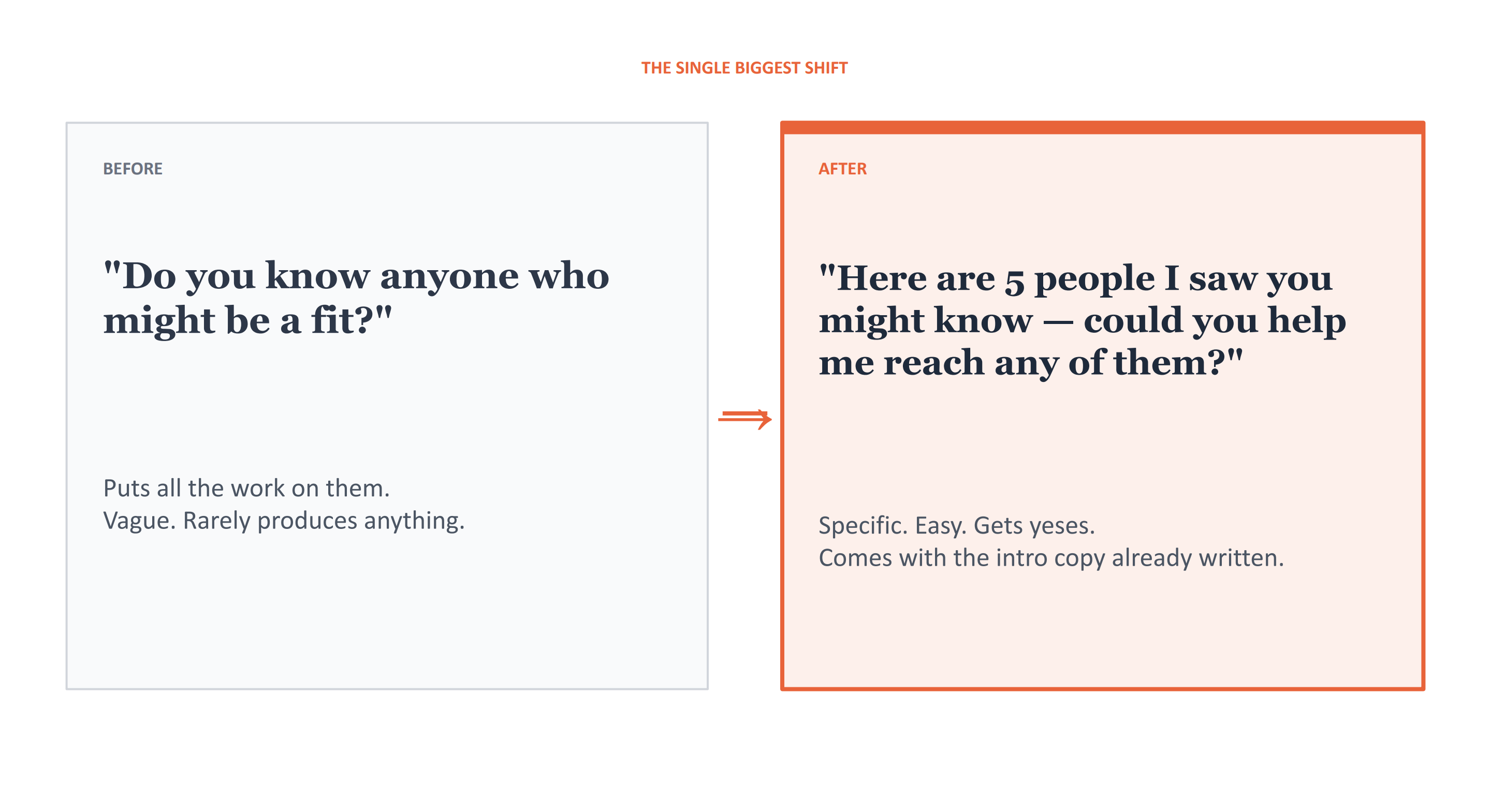
When you ask a partner or happy client, “Do you know anyone who might be a fit?”, you’re handing them a bale of hay and asking them to find the needles. They have to understand your value prop well enough to spot a match. They have to scan their network. They have to vet the fit. They have to worry about their own reputation if you handle the call badly. Then they have to write the intro email.
It’s too much work. So they say, “I’ll keep an ear out.” And nothing happens.

The fix is reversing who does the work. Instead of asking them to dig through the haystack, you find the needles yourself and hand them over. The new ask sounds like:
“I saw you might know these specific people. Can you help me reach them?”
That shift is what makes the rest of the system work.
Two myths to get past first
Before the tactics, two things you have to stop believing.
Myth 1: My network is tapped out. Almost always false once you actually look. Past clients, past prospects who couldn’t buy, vendors, friends in your industry, non-competing peers, people on your team. New people enter your orbit every week, and most of them disappear into a void. Your network isn’t tapped. It’s neglected.
Myth 2: Referrals don’t scale. Reactive referrals don’t. Proactive referrals do. Law firms, consulting shops, and Silicon Valley investment firms run nine and ten-figure books off small handfuls of relationships. The difference isn’t the network’s size. It’s whether you work it proactively.
The 5-step process
Step 1: Map your referral-ready connectors
Don’t open LinkedIn yet. Start with who you can name from memory. Aim for 15 to 25 people you’d genuinely feel comfortable asking for help.
Pull from every category you’ve got:
Current and former clients
Past prospects you had a good rapport with but couldn’t close (timing, budget, scope)
Non-competing agencies and consultants serving your buyer
Vendors and partners
People from previous jobs
Friends in your industry
People on your team (if you have one)
Most solos and agency owners start this exercise convinced their network is empty. By the end of an hour, they’ve remembered enough people to keep them busy for six months.
Step 2: Qualify on comfort first, then access
Two gates, in order. Don’t skip ahead.
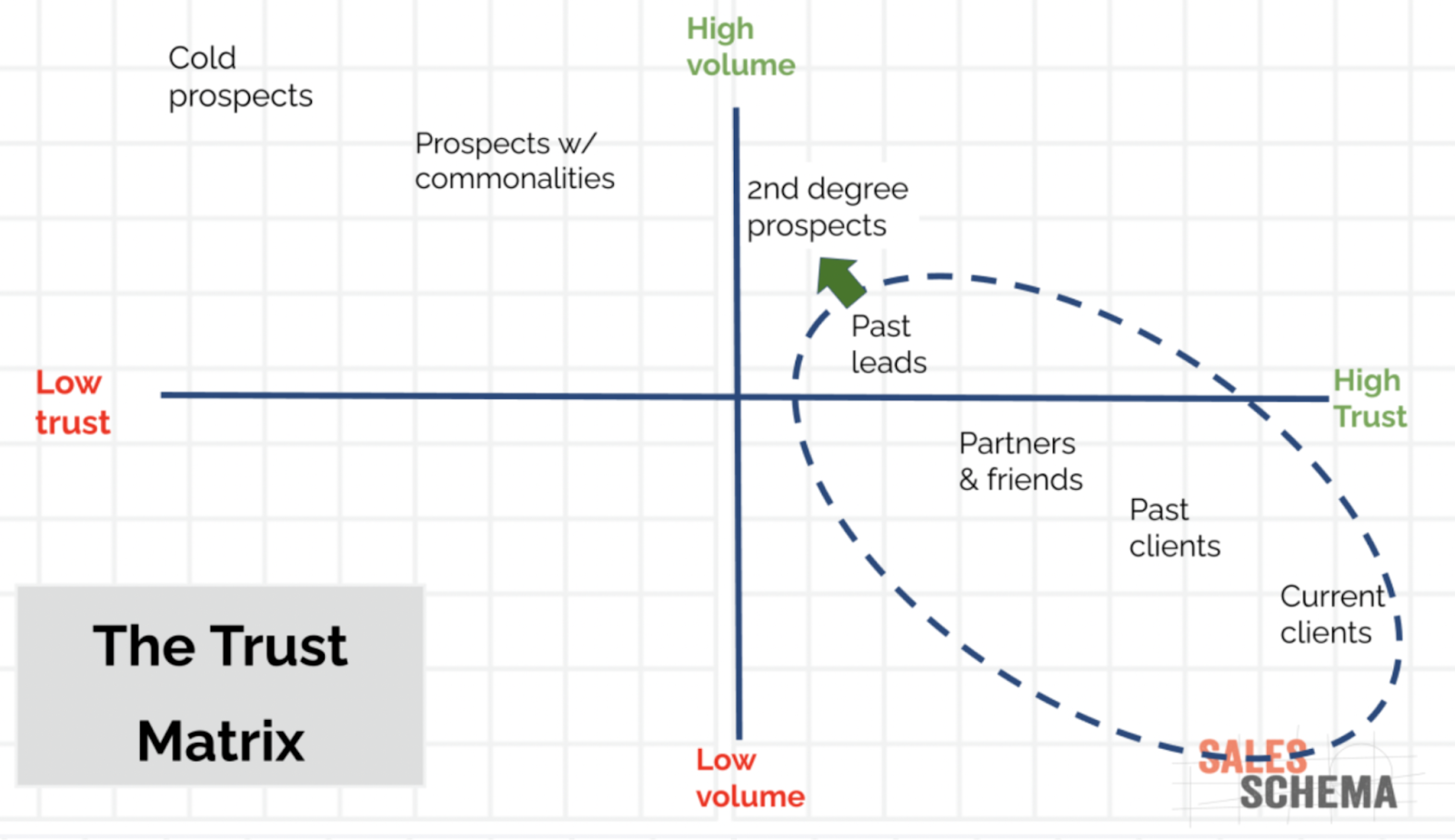
Gate 1: Comfort. Would you actually feel comfortable asking this person for help? Not “are they a nice person?” Not “do they like me?” Would you send them a direct message today asking for intros? Green light only. Yellow goes in a “build rapport first” pile.
Gate 2: Access. Only for the names that cleared Gate 1. Spend two to five minutes per person on LinkedIn. Roughly how many of your target prospects are they connected to? Use a stoplight: 0-5, 6-20, or 20 or more.
The double-greens (high comfort and high access) are where you spend your time first. That bucket alone often produces three to six months of work.
Step 3: Get buy-in before you do the prospect research
Most people get this backward. They build a wishlist, then pitch a connector cold on helping with the whole thing. That’s a lot to swallow.
Reverse the order. Get a yes on helping in principle first, then bring the names.
For a connector you’re already in regular contact with, a short email works:
“Hope you’ve been well. I’m building some new relationships in [vertical] and noticed you might know a few people I’m hoping to meet. If I ran some names by you, would you be open to making a couple of intros to those you know?”
If you haven’t spoken with them in a while or they’ve recently moved companies, book a quick call. The call is worth more than the email anyway. You’ll get market intelligence you can’t get from a Google search or ChatGPT: who’s actually making decisions inside the account, what’s broken right now, who to avoid, and what’s not in any article. People will tell you things on a call they’d never put in writing.
Step 4: Remove friction with an editable template
Once they’ve said yes, the work shifts to you.
Send 5 to 20 specific names, with the explicit caveat that they don’t have to be comfortable making intros to all of them. Let them pick the ones that feel natural. For each one they select, send back a pre-written intro template for them to edit and forward.
The template should do two things:
Sell the conversation, not your service. You’re not asking the prospect to buy. You’re asking them to spend 30 minutes with someone who might be a useful future resource. That’s a much smaller ask.
Use a horizontal relationship. Frame the intro as mutual: “Bob, you should talk to Karen for these reasons. Karen, you should talk to Bob for these reasons.” That recreates the psychology of an organic referral and keeps the prospect from feeling chased.
If you want a simpler one-off version of this step using a single happy client, I wrote up the DM-and-forward-email pattern I’ve been testing here. Same principle, smaller scope.
Step 5: Make it repeatable
The system scales in three ways:
The sprint (annually). Run the full mapping process once a year. New connections will have entered your orbit. Re-rank, re-engage, repeat.
The jog (trigger events). Bake the process into your normal workflow. You close a happy client → run the engine. You finish a great call with a prospect who can’t buy right now → run the engine. You meet a non-competing peer → run the engine. Every meaningful new relationship goes into the funnel instead of into a void.
Strategic partners (ongoing). Over time, a small group of connectors will keep sending you quality intros. Those are your strategic partners. Double down there. Ask them what they want in return: commission, mutual intros, audience sharing, nothing at all. Different people are motivated by different things, and the wrong assumption is that a single engagement model fits everyone.
A note on the call after the intro
This was the question a member raised in the workshop, and they are not the only one who’ll have it:
Once the intro lands and you’re on a call with the prospect, how do you turn it into a sales conversation without it feeling like a bait-and-switch?
The principle that matters most: never trick someone into a sales call. If they think they’re showing up for networking and it turns into a pitch, you’ve burned the prospect and burned your connector’s reputation along with it.
There are two clean ways to handle this, and the choice is mostly a question of how directly you signal the purpose up front.
The direct path. State the reason in the intro itself. “I looked at your site and noticed a few things I think I can help with. Would you be open to a call?” Now they know it’s somewhat of a sales conversation before they accept. The ones who show up are pre-qualified to talk about it.
The casual path. Keep the first call as a relationship call. Frame it at the top: “My goal here is to leave you better off. If we end up doing business, great. If not, that’s a win too. I’d like to be a future resource.” Ask permission to ask questions. If a real pain surfaces that you solve, name it plainly: “Not trying to pitch you, but that’s actually the thing I help with. Happy to schedule a separate call if it’s useful.”
Both work. What doesn’t work is hiding the ball.
One thing worth noting: the source of how a prospect found you affects how much trust they extend to you. People consistently grant more credibility to a resource that came through someone in their network, even if the timing isn’t right today. That’s part of why this system converts better than cold outreach.
What to do this week
Block 90 minutes. Build your shortlist of 15 to 20 names from memory. Assign comfort levels. Spend two to five minutes per person checking access on LinkedIn. Send three to five buy-in messages.
That’s it. If you do this, and you cut out the activity that isn’t actually producing meetings, 5 to 10 warm intros a month is realistic.
The reason most solos don’t have this is the same reason most solos don’t have a lot of things that work. It requires a regular habit, and the work doesn’t feel urgent until the pipeline is already empty.
Don’t wait for that.
If you want to go deeper into Dan’s process
Dan wrote a detailed written breakdown of this same process for my other newsletter, GTM Foundations, a few months back. It covers the workshop material plus the LinkedIn Sales Navigator setup he uses to build the system. Good read if you want to see the whole playbook in one place.
He’s also launching a course called Referrals by Design that packages everything into a working system. It includes his referral mapping template, a swipe file of the exact copy he uses for connector buy-in and triggering intros, walkthrough modules of the work he does himself, and a custom GPT that builds your intro templates for you. Normally $297, but Dan is offering it to 10x Solo members and newsletter readers at $197 one-time.
Keep building,
Garrett
P.S. When you’re ready, apply to join 10x Solo. Workshops like Dan’s run every week. Plus, you’ll meet other solos and micro-agency owners building similar systems.
Have questions or comments about today’s topic? Share them below. 👇