

Almost a year ago I talked with the founder of a custom dev agency. He and a partner had grown it to about $5 million a year, and he was stuck. “It’s so hard to grow,” he told me. “We’ve hit the ceiling.”
I asked who they sell to. “Anyone.” What do you build for them? “Anything they want.” How do you find clients? “Outbound and referrals.” They had tried lots of other channels, but none of them worked.
Light bulbs were going off in my head, but he hadn’t gotten there yet. It’s really hard to market something when you don’t know who the audience is or what exactly you’re marketing. Outbound and referrals can work even when you’re broad, because you adapt the message on the fly to whoever you’re speaking with. Content, ads, and other one-to-many marketing only start working once you’re clear on who you’re talking to and what you’re offering.
I ran last week’s 10x Solo workshop on this topic. A lot of the problems I see with solos that look like marketing, sales, or delivery problems come back to a lack of clarity on what I call offer-market fit. During this session, I walked the group through the worksheet I use with clients to pin it down.
Once your offer-market fit is clear and tight, everything else in your business gets easier.
What is offer-market fit?
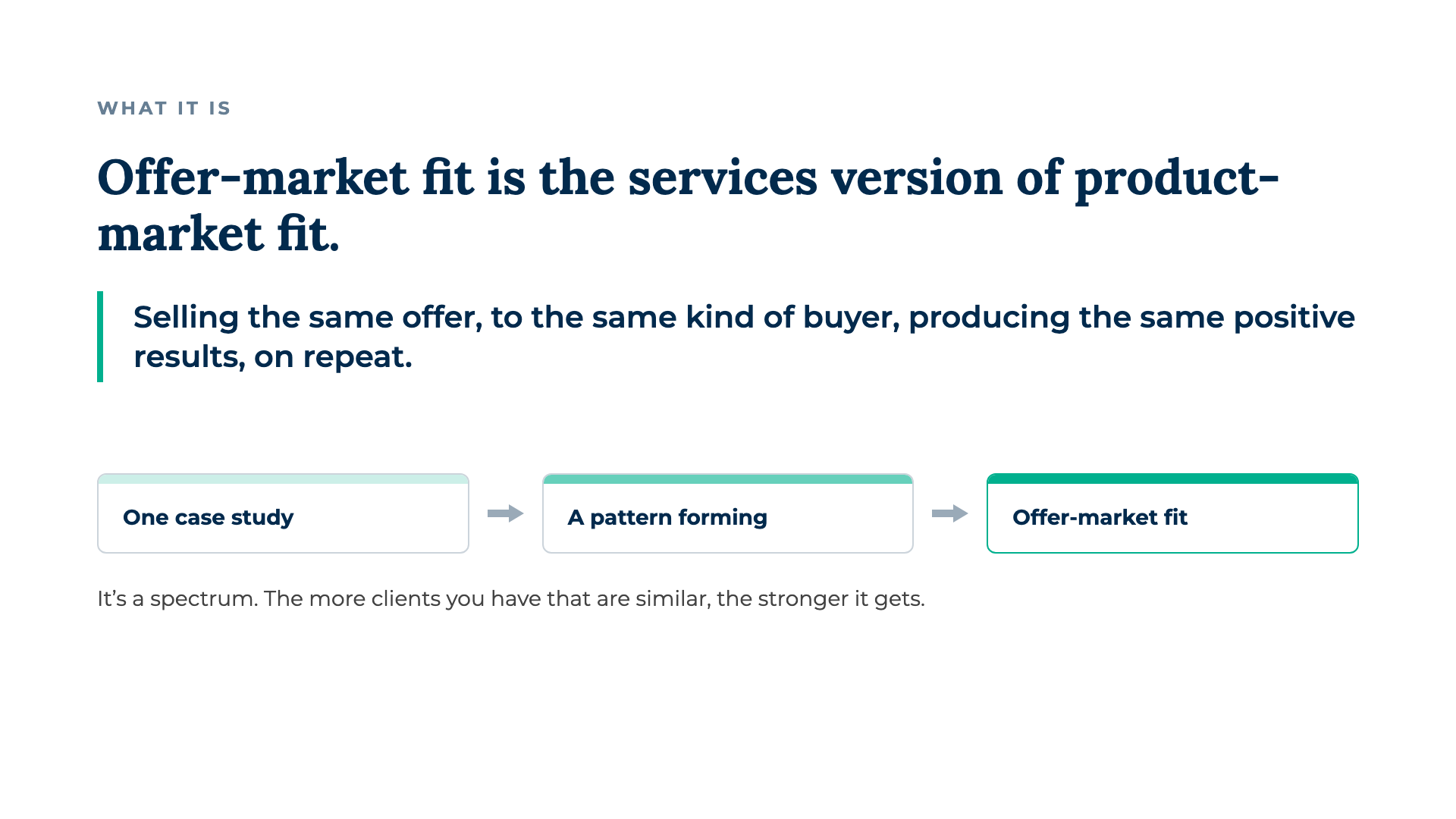
Offer-market fit is the services version of product-market fit. Much of my early career was working in early-stage software businesses. Once I went solo I realized this idea probably matters even more for services.
Here’s my definition: Offer-market fit is selling the same offer, to the same kind of buyer, producing the same positive results, on repeat.
I went deeper on the definition, the warning signs, and the data behind it in Offer-Market Fit: What Makes a Service Business Repeatable.
I see offer-market fit as a spectrum. You start with one great client, which gives you a case study. Then one or two more show up with almost the same use case, and a pattern starts forming. As more clients like that come on board, the fit gets stronger. The key here is repeatability.
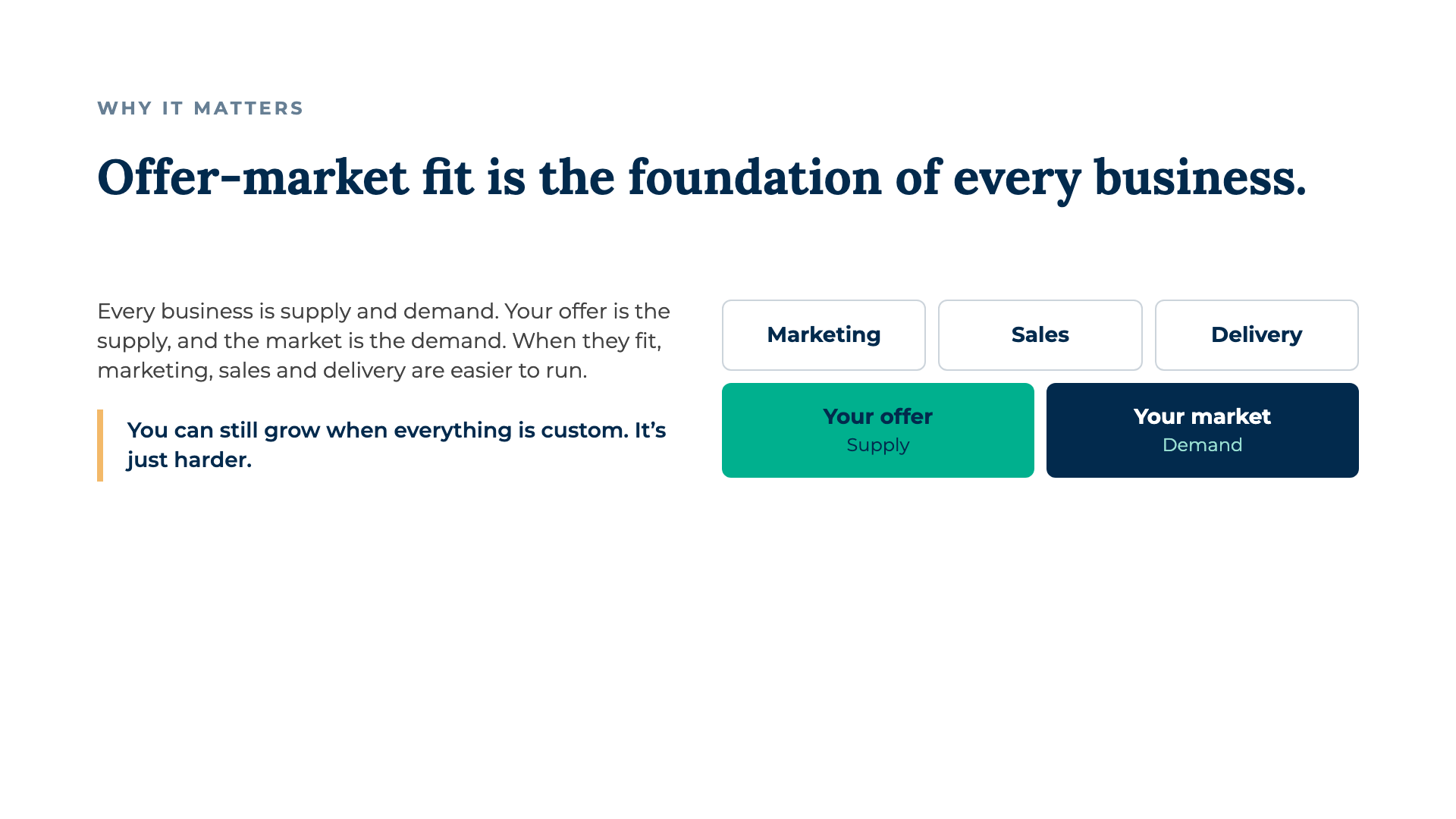
Why it matters comes down to supply and demand. Your offer is the supply. The market is the demand. When the two match, marketing, sales, and delivery get much easier to run. You can still grow when everything is custom. It’s just harder, as that agency owner found out.
When do you need offer-market fit?
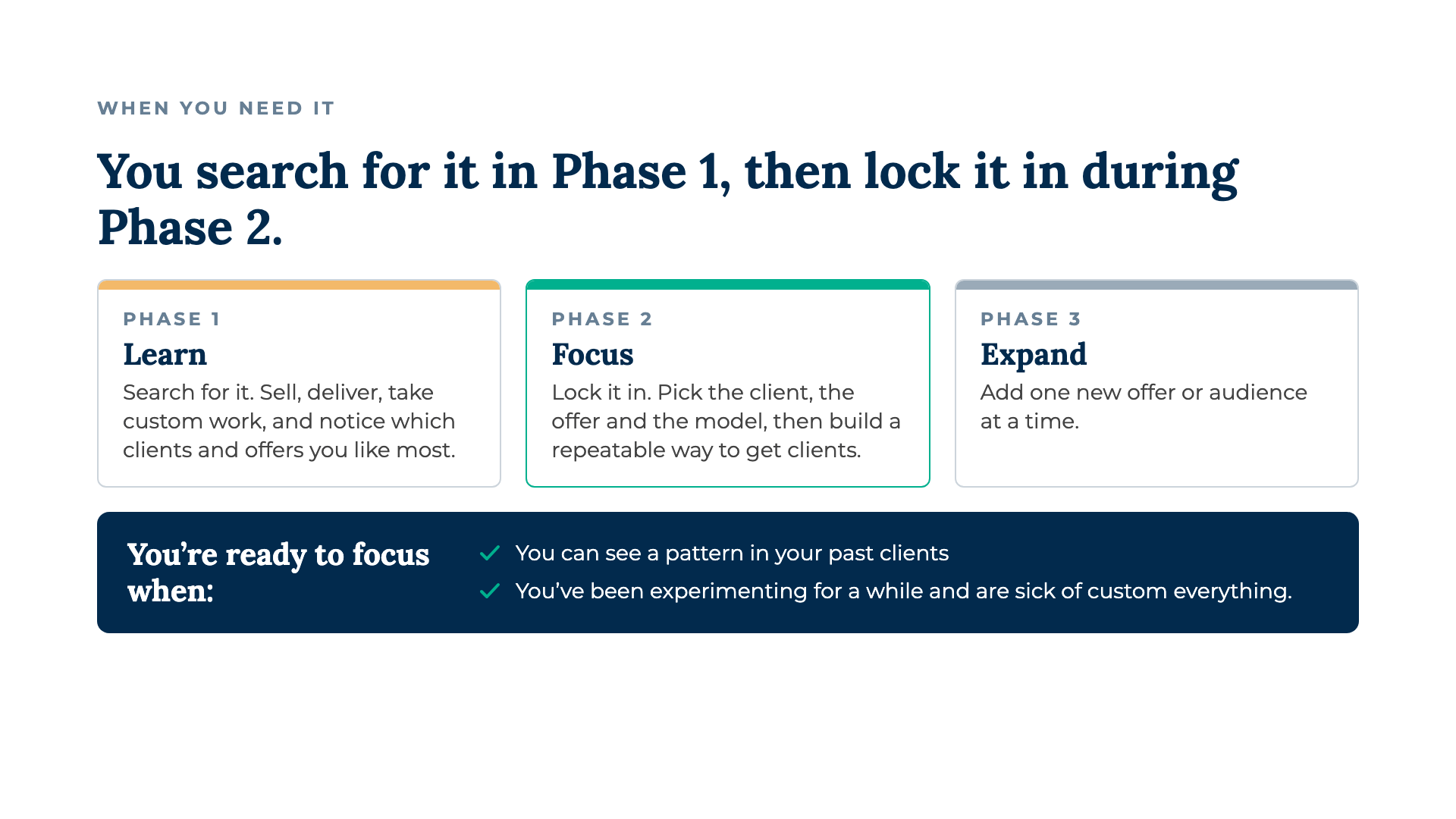
A lot of people say you need to niche down from day one. I disagree. Most of us go through three phases of growth.
In Phase 1 you’re still learning. You sell, deliver, take custom work, and notice which clients and offers you like most. Eventually one of two things happens: You see a pattern in the clients you’ve already served and decide to double down, or you get sick of the chaos of custom everything and want a simpler business to run. When one of those two things happen, it’s usually the sign to move into Phase 2 and focus.
The 10 P’s are the tool I use with clients to define offer-market fit and move into Phase 2.
The 10 P’s of offer-market fit
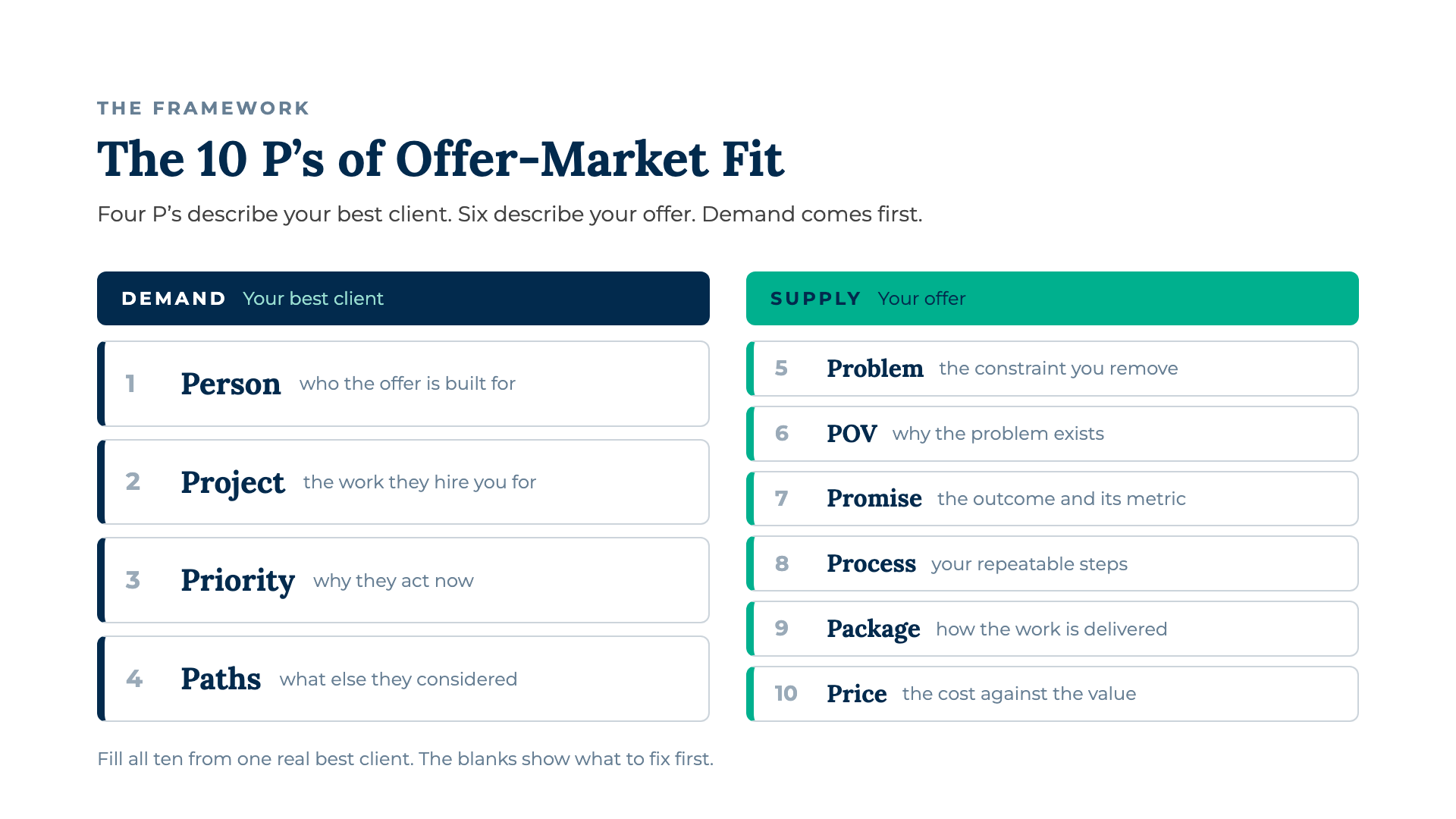
The first four P’s describe your best client, which is the demand. The last six P’s describe your offer, which is the supply. Demand comes first, because you can’t know what to offer until you know what people want from you.
Fill all ten in from one real best client, not a segment or Frankenstein ICP. If you can’t answer a P yet, leave it blank. The blanks show you what to fix first.
Demand: your best client
Start with who buys, and why they buy now.
1. Person. Who the offer is built for, based on one real client you want to replicate.
Best client: the named client you’re replicating, plus lookalikes if you have them
Persona: their role, key attributes, and why they buy
Company fit: firmographics, technographics, and other qualifying characteristics
Not for: who the offer can’t help, like the wrong problem, the wrong stage, or anyone who’d need a custom scope
You only learn these details as you sell and deliver.
2. Project. The primary workflow or project they hire you to accomplish.
A headline for the project
A 2 to 3 sentence description of the work
Your buyer doesn’t buy a service. They buy help with a project or workflow, something on their list for the quarter that they know they can’t do alone.
3. Priority. The triggers that make the project urgent enough to act now.
Each trigger as a headline in the buyer’s language
What happened that made them look now
More triggers as patterns emerge
“I want help with better marketing” with no good answer to “why now?” is probably a harder deal to close than “My board is pushing us to ramp up marketing this quarter.” That is a very different priority.
4. Paths. The alternatives they’ve already tried or considered, and why each one fell short, in their words.
Solve it internally or keep the status quo: the obstacles they can’t get past
Other options they weighed: why each one fell short
Do nothing: what keeps them there anyway, like habit or the fear of switching
A prospect with strong answers on all four P’s has strong demand. That’s also why these four make good discovery questions. On a discovery call, you’re pattern matching against your best client. If they look really similar, you know you’ll be able to deliver and get them similar results. If they don’t, you decide whether they’re close enough or whether you should introduce them to someone else.
Supply: your offer
Once you understand the demand from the best client you want to replicate, you can define an offer that fits it.
5. Problem. The core constraint your offer removes, something the buyer already measures.
External problem: the business-level number they track and want to move, plus the pains rolling up into it
Internal problem: what tolerating it costs the person hiring you, like burnout, pressure, or frustration
6. POV. Your belief about why this problem exists and why most Paths fall short in fixing it.
A headline belief
Tension 1: what’s broken about the status quo
Tension 2: why the common approach fails
Implication: what’s needed instead
Those four lines set the foundational context for everything else in the offer.
7. Promise. The big win you help them achieve, plus the business metric behind it.
A headline for the outcome promised
Business metric: the measurable improvement
Whatever the project, the buyer is betting you’ll help move some metric, even if they can’t name it directly. Part of being the expert is helping them see the impact and which leading indicators to watch.
8. Process. The 3 to 5 steps you walk every client through. Name it once you’ve run it the same way a few times.
The name of your method or framework
Each step: what happens and why it matters
9. Package. How the work is experienced and delivered.
Format: 1:1, group, or one-to-many
Effort model: done-for-you, done-with-you, or self-directed
Support: sessions, async, response times, cadence
Deliverables: the tangible assets you produce
What’s included: the extras, each one answering an objection you hear
Timeline: what happens when, including when they can expect the first tangible result
10. Price. What the offer costs, measured against what the outcome is worth to your best client.
Price: the amount and structure
Term: the commitment period and post-term options
ROI: a short description of how to frame the investment against the value
Price is where demand and supply meet. How strong the demand is, who it’s coming from, and how well your offer meets it all determine what you can charge.
How to use the 10 P’s
Start with the blanks. If you can’t answer a P clearly, that’s probably the one thing to fix first to strengthen your offer. Go mine your sales calls or talk to a few more clients until you can.
Use it as the source for everything you write. Your description of what you do, website copy, outreach messages, referral asks, follow-ups, proposals, one-pagers, case studies, and other content can all pull from it. It’s also a great context doc for AI. Before I write any offer content, I drop my 10 P’s into Claude.
Pressure test it, and update it as you learn. Pay attention to what lands with prospects who look like your best client, and to which clients get the best results once you’re delivering. Add what you learn as you go. A new trigger goes into Priority, and a new option a prospect mentions goes into Paths. It’s a living doc that gets stronger over time. And if your best client changes, everything else changes with it.
Fill in your 10 P’s this week
Block 20 minutes and do the following:
Pick one real best client, by name.
Fill in the four demand P’s from that client: Person, Project, Priority, Paths.
Fill in the six offer P’s: Problem, POV, Promise, Process, Package, Price.
Leave anything you can’t answer blank, then pick the first blank or weakest P to work on.
Drop the finished doc into Claude or ChatGPT before you write your next offer content.
Keep building,
Garrett
Just for 10x Solo members:
Last Thursday’s workshop: The full 10 P’s template is in the Notion library as a Google Doc you can copy and customize, along with the recording, the deck, and a 25-minute audio summary if you’d rather listen than watch. The recording includes the Q&A on free versus paid intro offers and where to draw the line on scope.
This Thursday: Speed networking and group discussion, run in small-group breakouts. The question we’re digging into is what’s working right now to bring in leads and clients, and what you’re testing. Come with one thing that’s working for you and one thing you’re trying. 10am MT / 12pm ET, already on your calendar.
In #asks-and-answers: A member hit a new client contract scary enough to send her looking into business insurance for the first time, and asked what the rest of us carry. 4 replies
P.S. When you’re ready, here are two ways I can help you:
Join the 10x Solo community. A private community of full-time B2B solos, fractionals, and small agency owners. Weekly workshops, honest peer feedback, and referrals. Apply here.
Work with me 1:1. For maxed-out consultants, fractionals, and agency owners who want to make more money in less time by creating a more repeatable offer and optimizing their marketing, sales, and delivery systems. DM me to set up a time to chat.
Have questions or comments about today’s topic? Share them below.
This hits. Before I quit my job to sell websites to local businesses, I asked 15 of them if a website was important. 8-10 said yes… but I never asked if they'd actually pay for one 😅
Outbound and referrals work when you’re broad because the founder is the one adjusting the pitch on every call, and that falls apart the minute you hand it to anyone else. Founder led sales is great until it becomes the ceiling. Which P do you see left blank most often? My bet is Priority.