
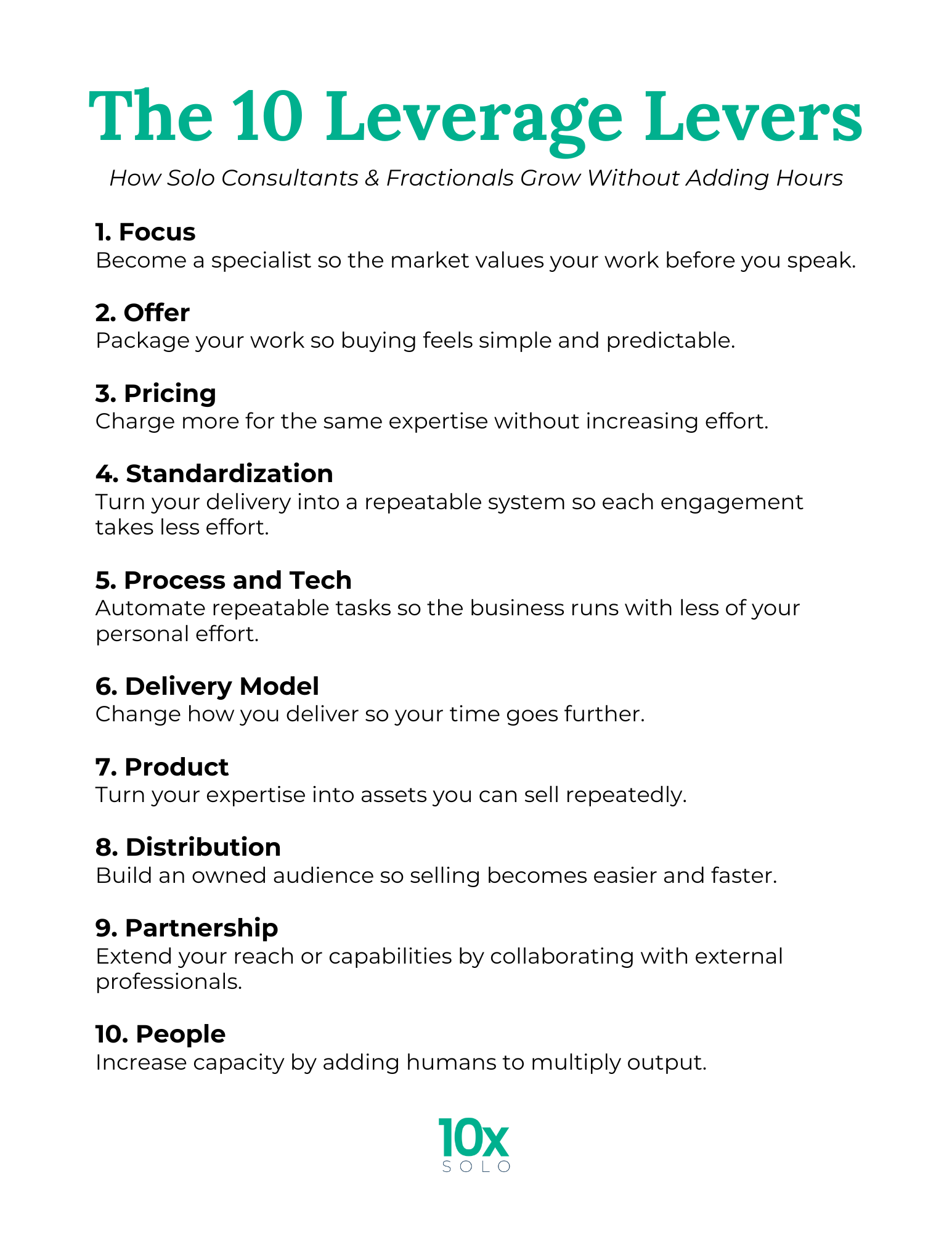
The 10 Leverage Levers
How Solo Consultants & Fractionals Grow Without Adding Hours

Most solos get trapped between two bad options:
Work more hours
Hire a team you do not want to manage.
But these aren’t the only ways to grow.
There are far more ways to increase income, capacity, and impact without increasing the hours you personally work. But most solos never see them because they only look through the lens of time or headcount.
That is the point of this article.
Before we get into the levers, we need a clear definition:
Leverage means creating more value than the hours you put in. A lever is the mechanism that makes that happen.
You pull the levers that fit the business you want to run.
You ignore the ones that do not.
You can stay a craftsman solo, operate as a fractional, build a one-person leveraged firm, or grow a small boutique agency. All of these paths work.
The goal is to understand the range of options and choose the ones that match the life and work you want.
1. Focus
Become a specialist so the market values your work before you speak.
My brother-in-law works as a trauma orthopedic surgeon. He earns north of $700k a year.
My general practice doctor earns closer to $200k.
Both went to medical school.
Both are competent.
Both work hard.
What explains the gap?
Not effort. Not intelligence.
Focus.
Generalists are interchangeable. Interchangeable work is cheap.
Specialists earn more because they solve a specific, high-stakes problem for a specific buyer. When the problem is urgent and the risk is high, price becomes secondary.
The same dynamic holds true for solo businesses.
If you “help companies with marketing” or “support founders with strategy,” the market struggles to understand your value. Buyers default to comparisons, and price becomes the shortcut.
When you solve one painful problem for one clear audience, the market does the math. Your relevance is clear. Your value needs no defense. The conversation shifts from rates to outcomes.
How to use this lever
Choose one audience or use case
Solve one urgent, expensive problem
Back it with proof you’ve done it before
Why this works
Specialists earn trust faster because the stakes are clear and the alternatives are few. They spend less time explaining their work, which shortens sales cycles and raises perceived value.
2. Offer
Package your work so buying feels simple and predictable.
This is not standardization. It comes earlier and matters more.
Offer leverage is about shaping what you sell. Delivery comes later. When your offer is clear, buyers don’t need explanations, comparisons, or custom calls to decide whether it’s right for them.
A strong offer is easy to understand. Easy to buy. And easy to deliver.
When I tightened my business down to one flagship engagement with clear outcomes, sales got easier overnight. Fewer questions. Faster decisions. Less time spent “walking people through” what I do.
How to use this lever
One clear flagship offer
Defined, concrete outcomes
A simple scope that buyers can say yes to immediately
Why this works
Confusion kills deals. A clean offer removes friction, increases win rates, and cuts pre-sale time before it ever hits your calendar.
3. Pricing
Charge more for the same expertise without increasing effort.
Pricing power doesn’t come from seller confidence. It comes from clarity.
When your focus is sharp and your offer is defined, you stop selling time and start selling outcomes. The work doesn’t change, but the way buyers value it does.
Hourly pricing ties your income to effort.
Outcome-based pricing ties it to results.
One scales. The other caps you.
How to use this lever
Replace hourly billing with fixed fees
Add tiered options tied to outcomes
Introduce retainers only when they make sense
Why this works
Clear outcomes make value easier to quantify. Buyers pay to remove uncertainty. You earn more without adding hours.
4. Standardization
Turn your delivery into a repeatable system so each engagement takes less effort.
Most solos lose time by rebuilding the same process for every client. The work may look different on the surface, but the underlying steps are often the same. Without standardization, you pay that cost again and again.
Standardization doesn’t mean rigid or cookie-cutter. It means deciding how you work once, then reusing it everywhere.
When the process is clear, execution gets lighter.
How to use this lever
Name your methodology
Define the steps from start to finish
Use consistent templates for recurring work
Why this works
You deliver faster and more predictably with less mental load. Standardization also creates the foundation for delegation later, if and when you want it.
5. Process and Tech
Automate repeatable tasks so the business runs with less of your personal effort.
Automation by itself isn’t leverage. Without a clear process, it creates noise and fragility. You move faster, but in the wrong direction.
Process comes first. Technology comes second.
When you layer automation on top of a standardized workflow, it removes friction instead of adding complexity.
The goal isn’t to replace judgment or expertise. It’s to eliminate the work that never needed either.
How to use this lever
Build custom GPTs or AI agents around defined workflows
Automate onboarding and recurring admin tasks
Use CRM workflows to handle follow-ups, tracking, and handoffs
Why this works
You stop spending time on work that doesn’t require expertise, which frees your energy for decisions that actually move the business forward.
6. Delivery Model
Change how you deliver so your time goes further.
Scaling doesn’t require a team. It often requires a different delivery model.
By shifting from 1:1 to 1:few or 1:many, you extend your impact without extending your hours. The work stays the same, but the audience grows.
Group delivery doesn’t dilute value when it’s designed well. In many cases, it increases it. Clients learn not just from you, but from each other.
How to use this lever
Small group advisory
Cohorts or masterminds
Paid workshops and live intensives
Why this works
You prepare once and serve multiple clients simultaneously. Revenue per hour increases without sacrificing quality.
7. Product
Turn your expertise into assets you can sell repeatedly.
Products are optional. They aren’t required to build a strong solo business. But when they align with the business you want, they can add leverage without adding complexity.
Product leverage works best when it grows out of real work. Proven frameworks, templates, and tools that already solve problems scale far better than ideas built in isolation.
How to use this lever
Courses based on work you already deliver
Templates or toolkits that replace repeat client tasks
Paid newsletters where readers pay for ongoing thinking and guidance
Why this works
Products generate revenue without requiring delivery each time. They extend your impact beyond your personal capacity.
8. Distribution
Build an owned audience so selling becomes easier and faster.
Distribution is not delivery. It is not operations. Its only job is to reduce friction in future sales.
When distribution works, you’re not persuading strangers. You’re talking to people who already understand how you think and trust your judgment.
The cleanest form of this leverage is simple: an email list of potential buyers you own. People who’ve learned from you long before they need your help.
This is why launching feels different when distribution is in place.
When I launched 10x Solo, I wasn’t starting cold. I already had friends and followers on LinkedIn who knew my work and trusted my perspective. When I reached out with an invite, many said yes immediately because the trust was already there.
That’s what distribution does. It turns launches into easy decisions.
How to use this lever
Build and grow an email list you own
Share useful, opinionated thinking consistently
Focus on trust, not reach
Why this works
You stop starting from zero every time you launch something new. Instead, you sell to a warm audience that already understands your value and is waiting for the next step.
9. Partnership
Extend your reach or capabilities by collaborating with external professionals.
Partnerships are not people leverage. They amplify what already works, without adding payroll or management overhead.
Partnership leverage is external. It lets you sell more, reach farther, or deliver better without owning every piece of the work. The right partners make your business bigger without making it heavier.
How to use this lever
Referral partners who serve the same audience
Affiliate sellers who can introduce your offer
Co-delivery with complementary specialists
Why this works
You expand what you can sell or who you can reach without hiring or managing full-time employees. Partnership leverage can blend distribution, product, and delivery into a single force, without the overhead that usually comes with scale.
10. People
Increase capacity by adding humans to multiply output.
This lever works. It’s also optional.
Some solos build their entire business around people leverage. Others avoid it completely. The difference isn’t ambition. It’s preference.
People leverage means adding humans to execute work, so you’re no longer the constraint. It works best when the system already exists, and others can run it without constant supervision.
How to use this lever
Contractors who execute a standardized process
Employees who own delivery or operations
Managers who remove you from day-to-day execution
Why this works
People leverage allows you to take on larger clients, handle more volume, or step away from delivery altogether. It’s the foundation of the agency model and the most common path to scale—but often it’s also the heaviest to manage.
The Point
You don’t have to choose between staying a lone solo or building an agency.
There are many paths in between.
Some consultants pull only a few levers and earn more while keeping things simple.
Some build leveraged solo practices through groups or digital products.
Some use partnerships to expand without adding staff.
Some build teams and scale through people leverage.
There is no single right model.
There is only the model that gives you energy and supports the life and income you want.
That’s the purpose of leverage.
Not to grow bigger.
To give you options.
Great read! One thing I'd like to add: each lever can propel another and work at different scales.
I like the model using the 6th leverage (Delivery Model) with a "proximity ladder," allowing you to ease your sales/delivery/offer by having tiers ranked by access to you (digital product > cohort > 1:1), for instance.
Was a great read. I really like where you're going with this newsletter!
Like your comprehensive focused approach, thanks for sharing