

Hi, I’m Garrett Jestice. I help maxed-out fractionals and consultants turn custom client work into one repeatable offer, and I write about how here every Tuesday. I also run 10x Solo, a private community where solo fractionals, consultants, and micro-agency owners compare notes on what’s working to grow their businesses.
New here? Start with Offer-Market Fit, then The 5 Parts of Your Client Factory.
In late August, Ruben Halfhide ran a workshop on LinkedIn DMs for our 10x Solo community. Ruben runs Uncomplicated, which helps agency owners and solos sign $50k-$250k clients through LinkedIn.
One member shared a real DM thread for Ruben to tear down. The member sells LinkedIn content services, but he’d opened by asking the prospect who their ideal client was so he could send them referrals. He thought his problem was the transition. The chat was friendly, but every move toward talking about business felt like he’d been buttering the prospect up.
Ruben, who warned us he’s Dutch and direct, called the opener disingenuous. The member wasn’t trying to trick anyone. He just felt he had to earn the right to bring up LinkedIn. But referrals had nothing to do with what he sells, so there was no natural way to get from there to his topic. “You don’t struggle with the transition. You struggle with the start. The start is 50% of your DM success.”
Ruben’s rewrite skipped the referral offer and went straight to LinkedIn, with something like “I saw you’re only posting once a week. I’m curious, do you have any ambition of getting more active on LinkedIn?” Now the conversation is about what the member sells from the start, so there’s no awkward pivot later.
That was the most useful thing I took from the session. The stage where a conversation dies is rarely the stage that broke it.
Two things I really like about Ruben’s approach:
First, sales is about serving, and you have to change your mindset to change your results from outreach. (I wrote more about this in “Sales is convincing a prospect to give me money”.)
Second, don’t be disingenuous. Don’t assume you can help anyone or try to sell them on anything until you’ve qualified them, and even then, you give them the choice to opt out.
So much of outbound feels fake because most people skip both. With Ruben’s approach, you’re just starting conversations to see if there’s someone you can help and moving on quickly if you can’t or they aren’t interested. Here’s how his Pitchless™ framework works.
The 5 stages of LinkedIn DM conversations
Ruben’s rule is to hit every stage, in order. Skip one and the conversation usually derails.
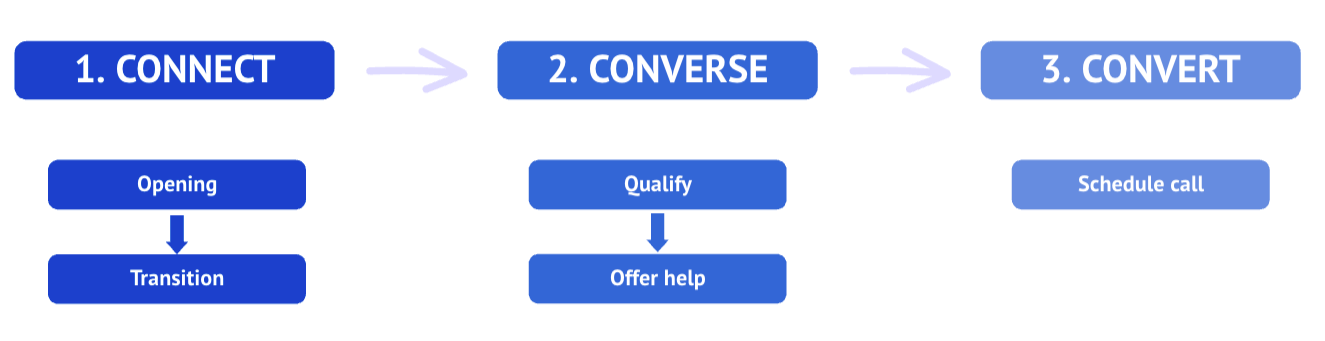
1. Open
Ask about something on their profile or in their content that aligns with your topic. Your topic is the problem you help clients solve. If you help with pricing, ask about pricing. If you help people with LinkedIn content, Ruben’s example opener is “Are you team anti or pro AI content?”
Skip talking about random stuff like cats, the weather, or anything about you. The exception is a cheesy pattern interrupt, if it fits your personality. Ruben’s is “How much does a polar bear weigh?” Whatever they guess, he answers, “Enough to break the ice.” Then he moves straight to a question about their business. Have 2 or 3 of your own to use if needed.
2. Transition
After a few messages, ask one question about how their business works today. Ruben helps founders book sales calls, so his go-to is “Do most of your clients come through referrals, or do you have some sort of system in place?”
3. Qualify
Run a mini discovery call in the DMs. Ask a few questions, one at a time, covering where they are now, where they want to get to, and what’s in the way. Ruben describes this stage as “finding a reason NOT to invite the other person to a call.”
Skip the advice. Don’t share strategy or diagnose their business yet. If someone won’t talk about their goals with you here, they weren’t going to buy anyway, and you both just avoided a call that wouldn’t go anywhere.
4. Offer help
When the person seems like someone you could help, ask one simple question: “Is this something you potentially want some help with?” Don’t describe your services yet. In Ruben’s words, “Have them decide. People are smart enough to make their own decisions.” If they say no, thank them and leave it there. Don’t push.
5. Book the call
If they say yes, offer a call. Ruben recommends offering two times instead of a booking link, since a link puts the work on them to find a time. For example, “I could meet tomorrow at 1 PM or 3 PM. Which of those works best for you?” Send your calendar link only if the back-and-forth on times stalls.
Find where your conversations die
Ruben tracks every conversation in his CRM with five statuses plus the outcome: opener sent, conversation started (the first positive reply), qualification, call proposed, call booked, then won, lost, or nurture. (A spreadsheet works fine to start.) The statuses show where your conversations stall.
If openers get no reply: The opener is generic, off-topic, sent to an inactive profile, or needs a follow up.
If replies come, then it dies at the transition: You pivoted to business too soon, so it feels like a pitch is incoming or you “buttered them up”. Spend more time between Opener and Transition.
If they won’t answer goal questions: Probably not a fit. Log it as lost and move on. There are plenty of people that match your ICP, have a problem you solve, and are super cool to talk to. Only spend your time with them.
A few rules for every message
Don’t be interesting, be interested. Interesting makes it about you. Interested makes it about them.
End every message with a question, so they always have something to answer. A big part of sales is leadership and by ending your messages with a question, you’re leading.
Ban “I love” from your DMs. Ruben’s test is simple. Name 5 things you love in your life. Ruben’s 100% convinced someone’s post or LinkedIn headline isn’t on that list. So saying it is disingenuous. You probably “like” or “appreciate” it.
Before you hit send, ask yourself what you actually want from this conversation. If your message says something else (like offering referrals when you really want to talk about business), rewrite it. Don’t fake stuff in the DMs.
Your invitation for the week
Pull your last 5 DM conversations that went quiet and look at how each one started. Then rewrite your opener so it starts inside your topic, and send it to one person who fits your best client profile.
Then keep going. Starting conversations with your ICP every day matters more than how many you send. Ruben compared it to working out. It’s less about how much weight you put on the bar and more about whether you keep showing up.
Just make sure each conversation starts inside your topic. The start is where most DMs are won or lost.
Keep building,
Garrett
Just for 10x Solo members:
Last Thursday’s workshop: Casey Silveria on building a capital allocation policy for lumpy income, so a written plan decides where your money goes instead of the emotion of a big check or a light month. His most useful point is that your reserve should be sized to your essential monthly spending, not your revenue, which for most consultants means 12-18 months rather than the 3-6 a salaried employee needs. The recording and the one-page worksheet are both in the Notion library.
This Thursday: Joe Daniels on the gap between deciding and acting, and his “doomcasting” process for getting past the fear and finally making the call. 10am MT / 12pm ET, already on your calendar.
In #losses-and-lessons: A member posting in English to a mostly Chilean network changed his profile location to the States, and his reach went up. His read is that LinkedIn won’t distribute into a market you haven’t told it you’re in, so adding people from that market first is the only way to open it. 10 replies
P.S. When you’re ready, here are two ways I can help you:
Join the 10x Solo community. A private community of full-time B2B solos, fractionals, and small agency owners. Weekly workshops, honest peer feedback, and referrals. Apply here.
Work with me 1:1. For maxed-out consultants, fractionals, and agency owners who want to make more money in less time by refining their business model, offers, and systems. DM me to set up a time to chat.
Have questions or comments about today’s topic? Share them below. 👇