

Nobody works for me right now. No assistant, no contractor. Every week a good chunk of my time goes to work I already know I want to eventually hand off. What keeps it on my plate is the same question I hear from most solos: “Is now the right time, or should I get the business more figured out first?”
A couple weeks ago Samantha Prestidge ran a workshop for the 10x Solo community called Build Your Bench. Sam runs a US-based virtual assistant agency, placing VAs, and spends her days with founders who say some version of “I don’t know what I need help with. I just need help.”
She’s also been through it herself. In January she hired an ops manager while every process in her business was out of date, and did it without writing an SOP.
This is her framework. I’m writing it up because it’s the most useful version of “how do I delegate?” I’ve seen.
Most delegation fails because you start with the tasks you want to hand off. This framework starts with the job you want to keep.
Why the usual advice doesn’t work
You’ve probably heard these pieces of advice:
“Hand off the low-level tasks.” Some days everything in the business feels like admin because you don’t want to do any of it. And if a task is truly low-level, why pay anyone to do it? Maybe it doesn’t need doing at all.
“Work smarter, not harder.” Sure. Agreed. What does that help you do differently on Tuesday?
“Get your SOPs written first.” Sam has a Lean Six Sigma background, so she isn’t anti-process. But if you’re at capacity, you don’t have time to stop and document how you do things before handing them off. Worse, SOPs set you up to hire an order-taker. Every handoff needs full instructions, so delegating becomes one more item on your list.
When a hire fails in the first 90 days, Sam usually sees two causes:
You rushed it. Usually because a big contract landed and you needed help yesterday.
The expectations were unclear. The job description was a pile of bullet points from your to-do list. Unclear expectations also means you can’t interview well. You don’t know what a green flag looks like.
The framework below is how you get clear expectations before you hire. And once you know what you’re hiring for, you’re much less likely to rush it.
Step 1. Map It
Break the business down from a bird’s-eye view so you can see what it takes to run.
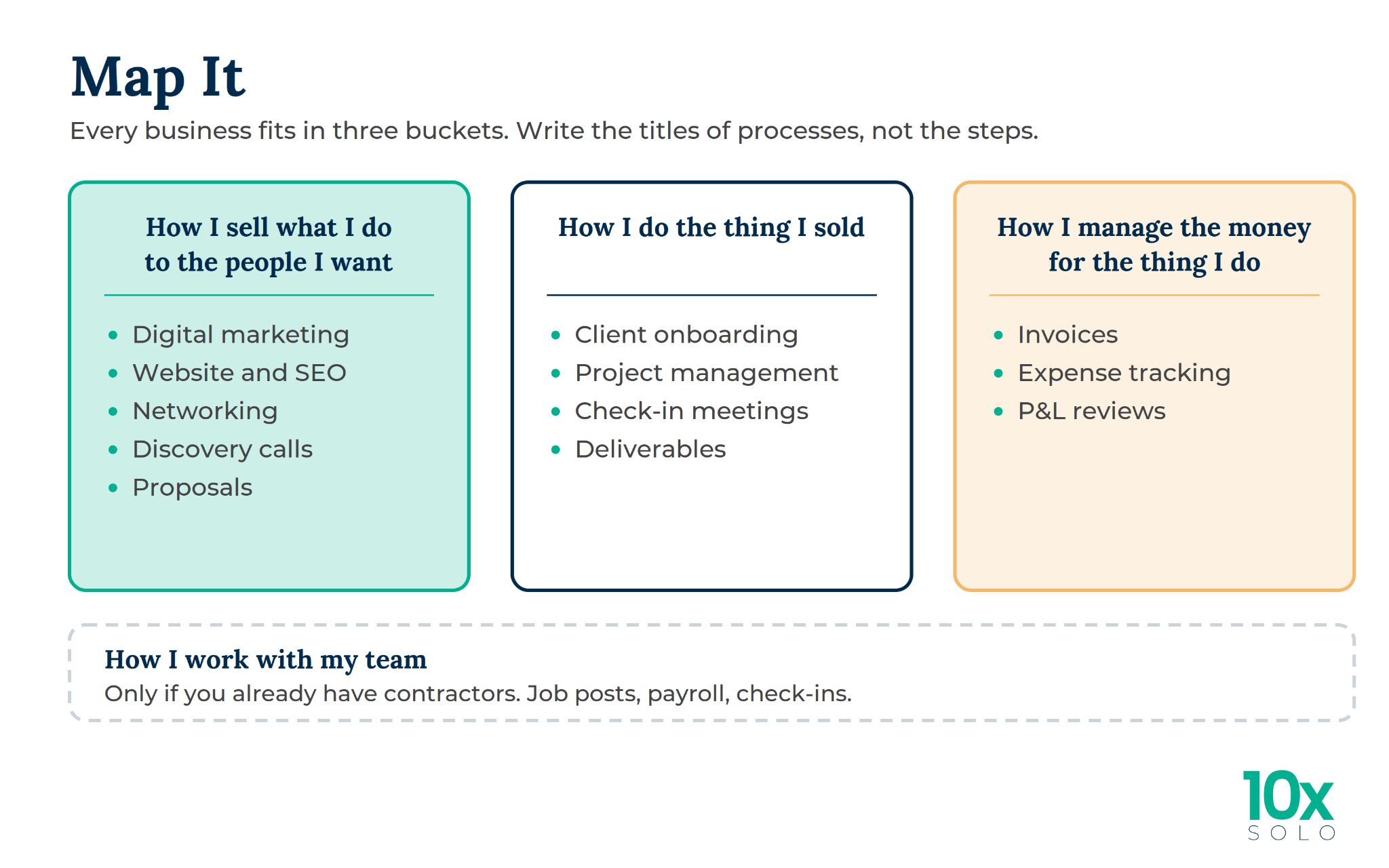
No matter how complicated your business feels, it fits in three buckets:
How I sell the thing I do to the people I want to work with. Digital marketing. Website and SEO. Networking. Discovery calls. Proposals.
How I do the thing I sold. Client onboarding. Project management. Check-in meetings. Deliverables.
How I manage the money for the thing I do. Invoices. Expense tracking. P&L reviews.
If you’ve read Traction, this is sales, ops, and cash. If you already have contractors, a fourth bucket wraps around the others:
How I work with my team. Job posts, payroll, check-ins.
Stay high level as you write this out. You’re mapping the titles of processes, not all the steps. In the workshop, Sam gave the room five minutes to do this, which tells you how much detail she wants.
This map also does a second job. It shows you whether your offer is standardized enough to begin to hand off. If every client gets something custom, you’ll see it here. Then, you can decide whether you need to fix that before you hire.
Step 2. Keep It
Write your own job description.
This is the step Sam called the most important, and the one most founders skip. Why write a job description for yourself? Because if you don’t know what you want your role to be as you grow, you can’t know what anyone else’s is either.
Two questions to ask yourself:
What are my strengths? The work you’re good at, love, and could do all day.
What are the founder-needed tasks? The things where, if you didn’t do them, you wouldn’t know what’s happening in your business. KPIs. The P&L. Sam calls this the grown-up CEO seat.
Founder-needed is not the same as “only I can do this.” If your offer is one-on-one coaching, yes, you’re the coach. That goes under strengths. Founder-needed tasks are about oversight, not execution.
If you ran the exercise from The Excellent Trap back in August, Keep It is the Unique Ability box.
For her own business, Sam’s keep list is picking podcast guests, writing her LinkedIn content, running sales calls, and matching VAs to clients. She won’t hand off any of the four.
Go back to your map and circle what you’re keeping. That’s your role once you have help.
Step 3. Delegate It
Identify the tasks you want to hand off and build the foundation of a job description. There are three parts to doing this well:
1. “I definitely need someone who can handle...” Circle the tasks on your map you want gone. Ignore budget and cash flow for now. Then look at the circles. Do they belong together in one role, or is it two? And before you hire for any of it, ask what could be automated or handed to an AI tool, and what needs a human.
2. “It’d be cool if someone could...” What projects have you procrastinated on? What have you wanted to do for clients but never had time to execute? The Substack that could also be a blog. The welcome box a new client gets in the mail. These feel like shiny objects because you’re at capacity, but if they’d raise the level of the business write them down. Someone else could own them.
3. “Success in this role means they will own these outcomes.” This is the part Sam says matters most, and where most founders get it wrong.
The wrong version of this: “If I delegate [XYZ], then I’ll have more time for [this thing I want to do].”
She hears this constantly. “If I get an admin to handle the back-office stuff, I’ll have more time for business development.” Admin has nothing to do with business development. You’ve tied someone’s work to a goal they can’t control. And if you haven’t mapped the business, “more time for business development” usually means you go network more and feel exhausted with nothing to show for it.
The right version of this: “If someone effectively owns [XYZ], that will result in [this outcome for the business].”
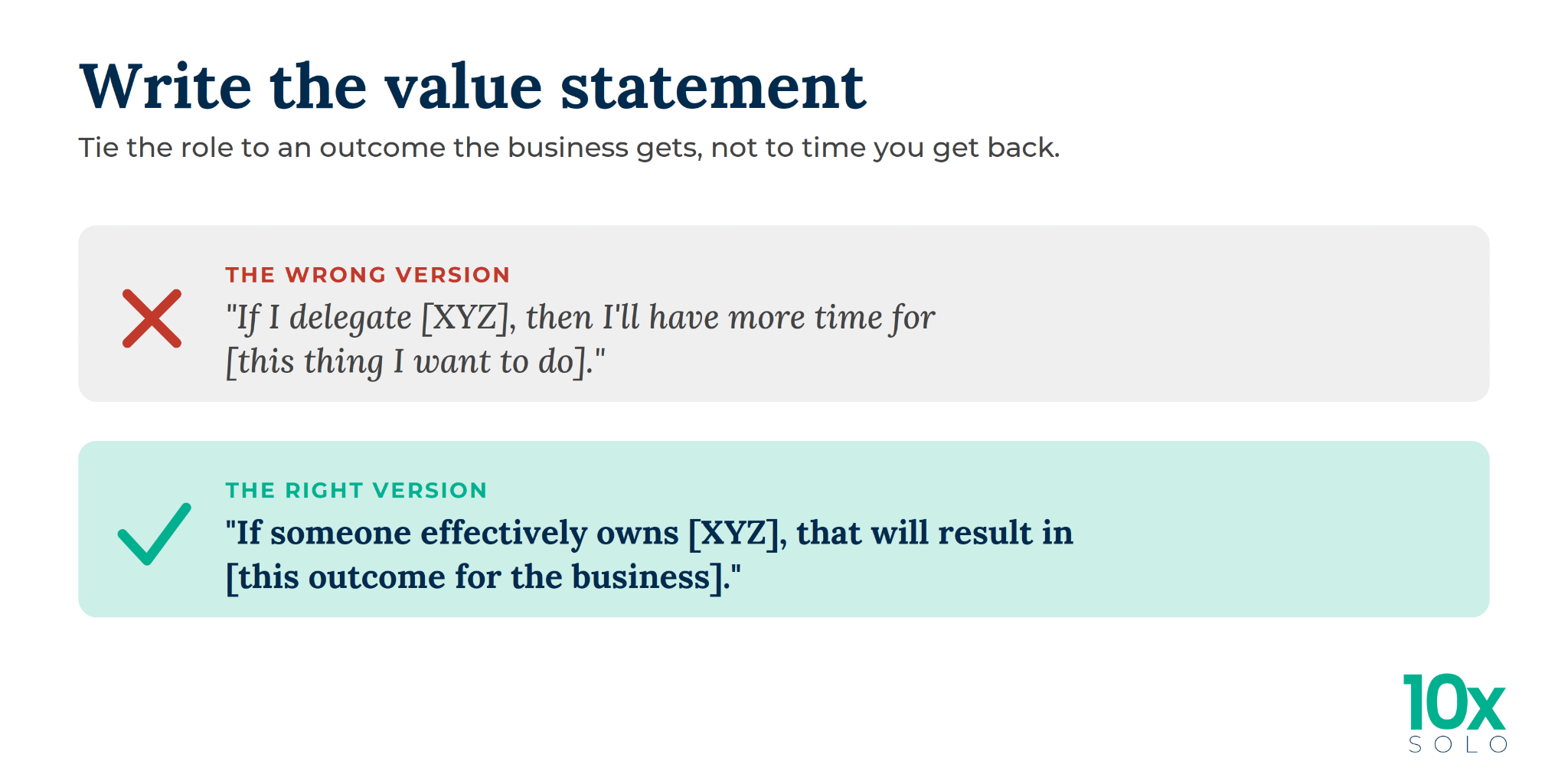
Sam’s own example: “If my ops manager owns onboarding, VA management, hiring support, and invoicing, our clients have a more consistent, high-quality experience, resulting in higher retention and more referrals.”
Every expectation she sets for that role traces back to client experience, retention, and referrals. The person knows what they’re there to move, so she can delegate outcomes and decisions instead of checklists. That’s why the SOP can come later (or never).
When to do this
I asked Sam the question most of us were wondering: “Should I hire now, or after things are more fleshed out?”
Her answer came back to goals and cash flow. This framework assumes you’re at capacity and ready to hire, and that’s not always true. So put your map and your keep list next to where you are against your goals and what you can afford. From there, it’s a choice between bringing someone in for a few hours a week so they can grow with you, or holding off.
One thing she added. If the role has a slow payoff, budget for the wait. One member’s value statement had an assistant owning lead generation. Sam’s pushback was that warm, relationship-based lead gen takes four to six months to produce anything. Can you pay someone part-time for six months before it shows up in the pipeline? If not, consider handing off other sales and marketing tasks and keep the relationship work yourself.
Putting it together
After you run the three steps, you’ll have three things:
A map of the crucial processes it takes for your business to function.
Your own job description.
The foundation of a job description for your next team member (which is the delegate list plus the value statement).
That third one is the piece most of us skip. We think we need SOPs when what we’re probably missing is a clear picture of the role and the outcome we’d hold the person accountable to. If you have those two things, you can hire someone who can make decisions instead of handing them a list of tasks. That’s what makes a hire feel like relief instead of one more thing to manage.
Keep building,
Garrett
Just for 10x Solo members:
The recording from Sam’s Build Your Bench workshop is up in the Notion library, along with the Canva whiteboard template for running the three steps on your own business.
This Thursday’s workshop: Mike Grinberg on the four constraints that quietly kill founders and their firms. You’ll run a few exercises from his Owner’s Clarity workbook and get the full toolkit afterward. 10am MT, already on your calendar.
In #asks-and-answers: “Do y’all find attending B2B marketing conferences valuable for referrals? If so, which ones do you recommend?” 9 replies
P.S. When you’re ready, here are two ways I can help you:
Join the 10x Solo community. A private community of full-time B2B solos, fractionals, and small agency owners. Weekly workshops, honest peer feedback, and referrals. Apply here.
Work with me 1:1. For maxed-out consultants, fractionals, and agency owners who want to make more money in less time by refining their business model, offers, and GTM systems. DM me to set up a time to chat.
Have questions or comments about today’s topic? Share them below. 👇
The shift from delegating tasks to delegating outcomes is interesting. It seems to change more than workload. If someone knows the outcome they’re responsible for, they have a boundary around the work but still have room to decide how to get there. I wonder how much that combination of clarity and agency changes what people are able to learn through the work itself.