

Hi, I’m Garrett Jestice. I help maxed-out fractionals and consultants turn custom client work into one repeatable offer, and I write about how here every Tuesday. I also run 10x Solo, a private community where solo fractionals, consultants, and micro-agency owners compare notes on what’s working to grow their businesses.
New here? Start with Offer-Market Fit, then The 5 Parts of Your Client Factory.
Picture a farmers market on a fall Saturday. You see a whole row of strawberry stands. Every stand has a farmer talking about why his strawberries are so great: his harvest methods, his varietals, and the bakeries that buy from him. But you walk past all of them, because none of them has any strawberries on the table.
Then one stand has crates of them stacked high. That’s where the crowd is.
Wes Wheless opened his 10x Solo workshop last week with that picture. He explained that most solo consultants run the first kind of stand. We talk about our expertise, but we rarely show it.
Wes spent 20 years in corporate, from BCG to Reforge, where he turned tech executives’ ideas into course content. He went solo in 2022 and now does the same for solo consultants, building what he calls “intellectual headshots,” visuals that make your expertise easy to see and understand at a glance. His book, The Expert’s Privilege, covers the method below.
Of all the visuals he builds with clients, the one they say gets them in the door most often is the one that shows their buyer’s pain.
Lead with a picture of your buyer’s pain. Your framework can wait until later.
Your story has six parts. Start with the second one.
Every expertise business tells its market a story. Wes calls it the narrative spine.
ICP: The human decision maker who hires you.
Pain: What that person feels.
Problem: The business issue they want fixed.
Point of view: How you see the space, often your signature framework.
Solution: Your path from problem to result.
Service: How you package it so they can hire you.
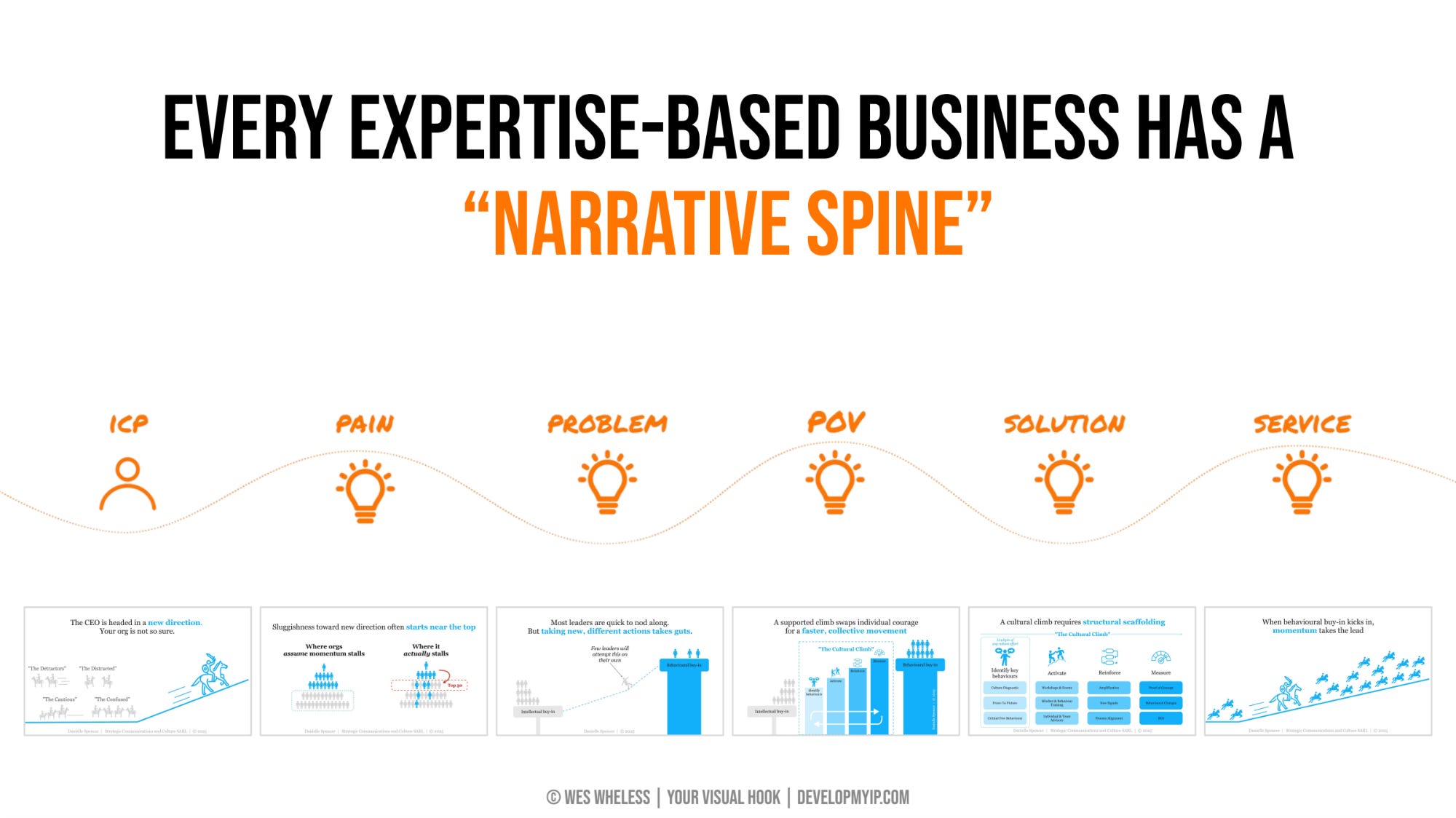
You can build a visual for every part. But the pain visual is the one that attracts new clients, for three reasons:
It builds empathy, because a buyer who needs help wants proof you understand.
It builds trust, because naming a feeling they couldn’t name earns credibility before you mention a framework.
It creates urgency. People save a framework for later. They respond to their pain, because they feel it every day.
Step 1. Name your buyer and their pain
Write down who buys from you and what they feel.
Wes shared an example of a CEO who rolls out a new strategy the org won’t follow. That’s the problem. The pain is how the CEO feels about it. Alone out front. Embarrassed that it isn’t catching on. Reach for words like frustrated, scared, stuck, under pressure.
Then try to draw it. Wes gave the room one minute, and almost everyone drew some version of a stressed person. Most buyer pain is invisible, and a picture of a frustrated person looks like every other picture of a frustrated person. Nobody stops scrolling for it. That’s why you can’t stop at naming the feeling. You need something your buyer can see.
Step 2. Find the parallel
Since you can’t draw the feeling, find a metaphor for it. Ask what the underlying tension is, and where else it shows up in the world.
Three of Wes’s client examples:
A growth coach works with CEOs who have become the bottleneck for everything. They feel exhausted and too indispensable. The metaphor is a CEO directing traffic in the middle of an intersection, cars coming from every direction.
An AI expert works with non-technical founders who raised money on a hastily built model. They’re nervous it will all come down. The metaphor is a Jenga tower of funding, marketing, hiring, and sales stacked on one small AI block.
A brand strategist works with CEOs whose org is slow to adopt a new vision. The metaphor is a leader planting a flag on a hilltop, dragging the org up behind them on a rope while people fall off the back.
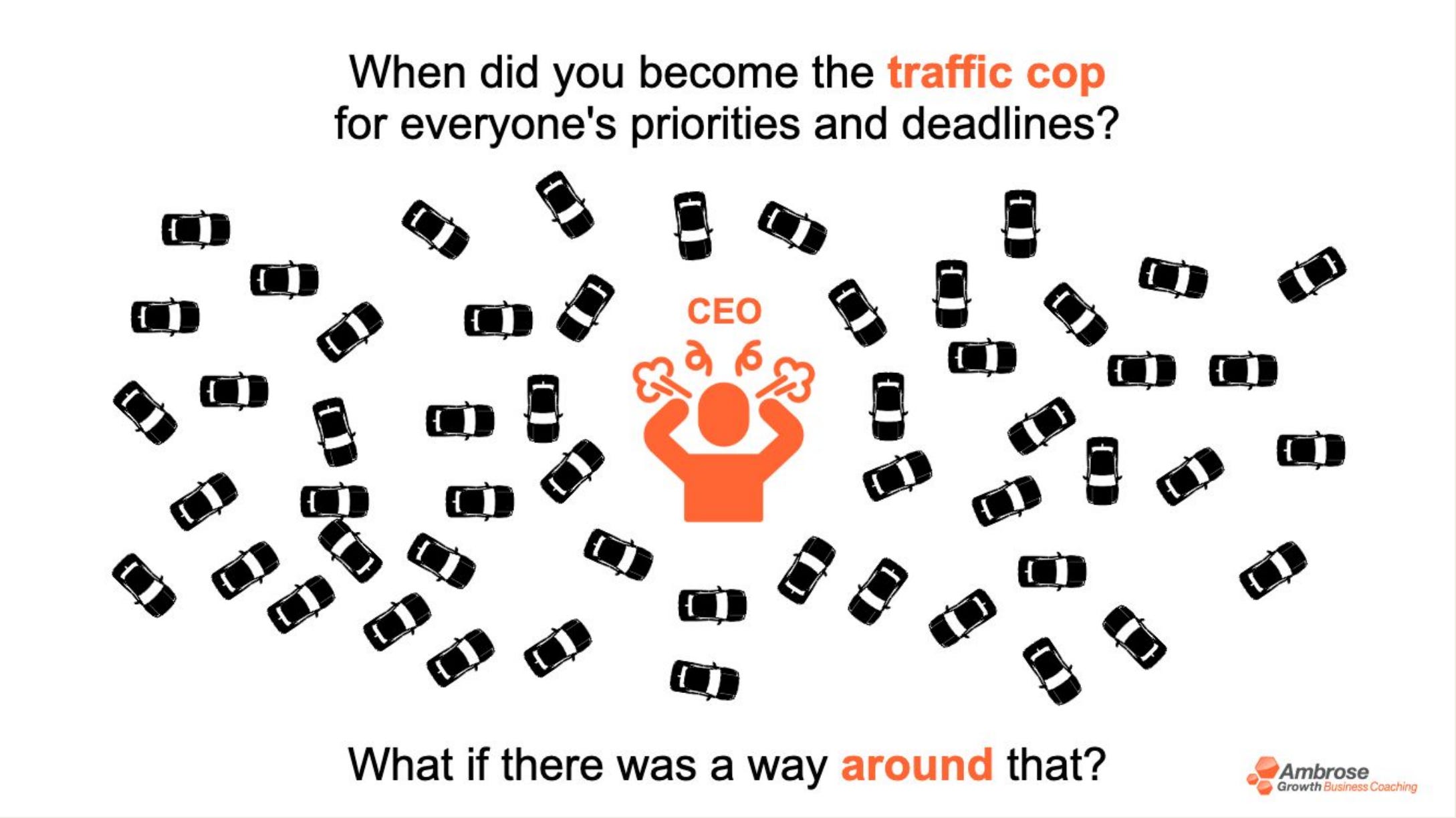
Each one carries the emotion without showing a single stressed face.
If nothing comes to you, use Wes’s metaphor prompt. Copy it below, fill in the brackets, and run it in ChatGPT. It returns 10 metaphors, each with a one-line description, why it fits, and a caption.
I'm a B2B consultant who helps [TYPE OF CLIENT / ROLE].

One pain point they experience is:
[DESCRIBE THE PAIN POINT IN 1-2 SENTENCES]

When they experience this, they tend to feel [EMOTIONS: e.g., frustrated, trapped, overwhelmed, uncertain, exposed] because [WHY THIS SITUATION IS DIFFICULT OR HIGH-STAKES FOR THEM].

Generate 10 different visual metaphors that could represent this pain point.

For each metaphor:
1. Describe the visual in one sentence.
2. Explain in one sentence what makes it analogous to the client's situation.
3. Give me a short phrase or caption that could accompany the visual.

Prioritize metaphors that are:
- Instantly understandable without explanation
- Based on familiar objects, situations, or experiences
- Simple enough to depict in a single illustration
- Visually distinct from one another
- Specific enough to be memorable
- Focused on the pain, not the solution

Avoid generic business imagery such as lightbulbs, handshakes, puzzle pieces, targets, gears, funnels, chess pieces, and people climbing mountains.

Push beyond the first obvious metaphor. The goal is for my buyer to look at the metaphor and think almost instantly, "Yes. That's exactly what this feels like."
Expect half the results to be weak. But you only need one. For a climate tech CEO whose strategy kept getting wiped out by new regulations, Wes’s list included a rug pull, a moving finish line, and a sandcastle at high tide. He picked the sandcastle.
Step 3. Paint the picture
Draw it yourself or ask ChatGPT to generate it. Plan to iterate. A metaphor can sound right as a sentence and fall flat as an image.
Wes’s sandcastle came back as a polished photo. It looked great, and it looked AI-generated, which may not be how you want your business to show up. One more prompt turned it into a pencil sketch, which is much easier to post or put on a slide.
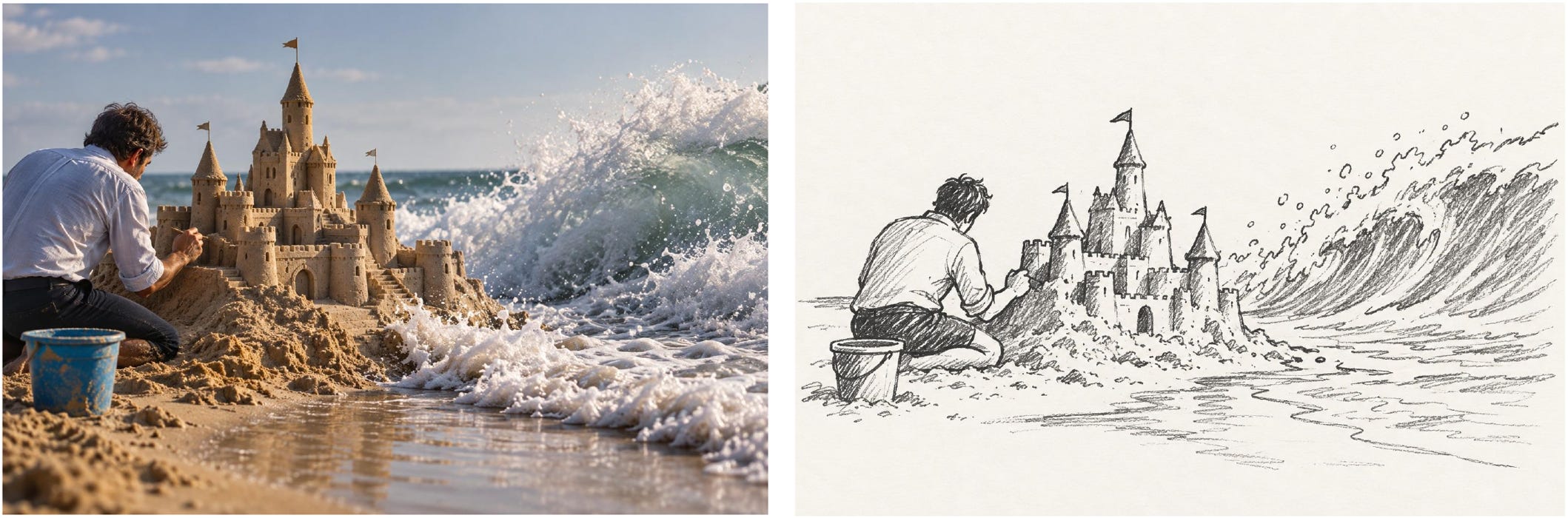
When the metaphor fits, the buyer can’t unsee it. Even if they don’t hire you this month, the image sticks with them, and that can bring them back later or have them refer someone else your way.
Test it on LinkedIn first
Once you have an image, put it in front of buyers and see how they react. Wes suggests LinkedIn as the testing ground, since it’s where most of us already share content.
Wes splits the narrative spine across three places:
The visual carries the pain.
The post carries the problem and your point of view.
Your profile carries the solution and the service.
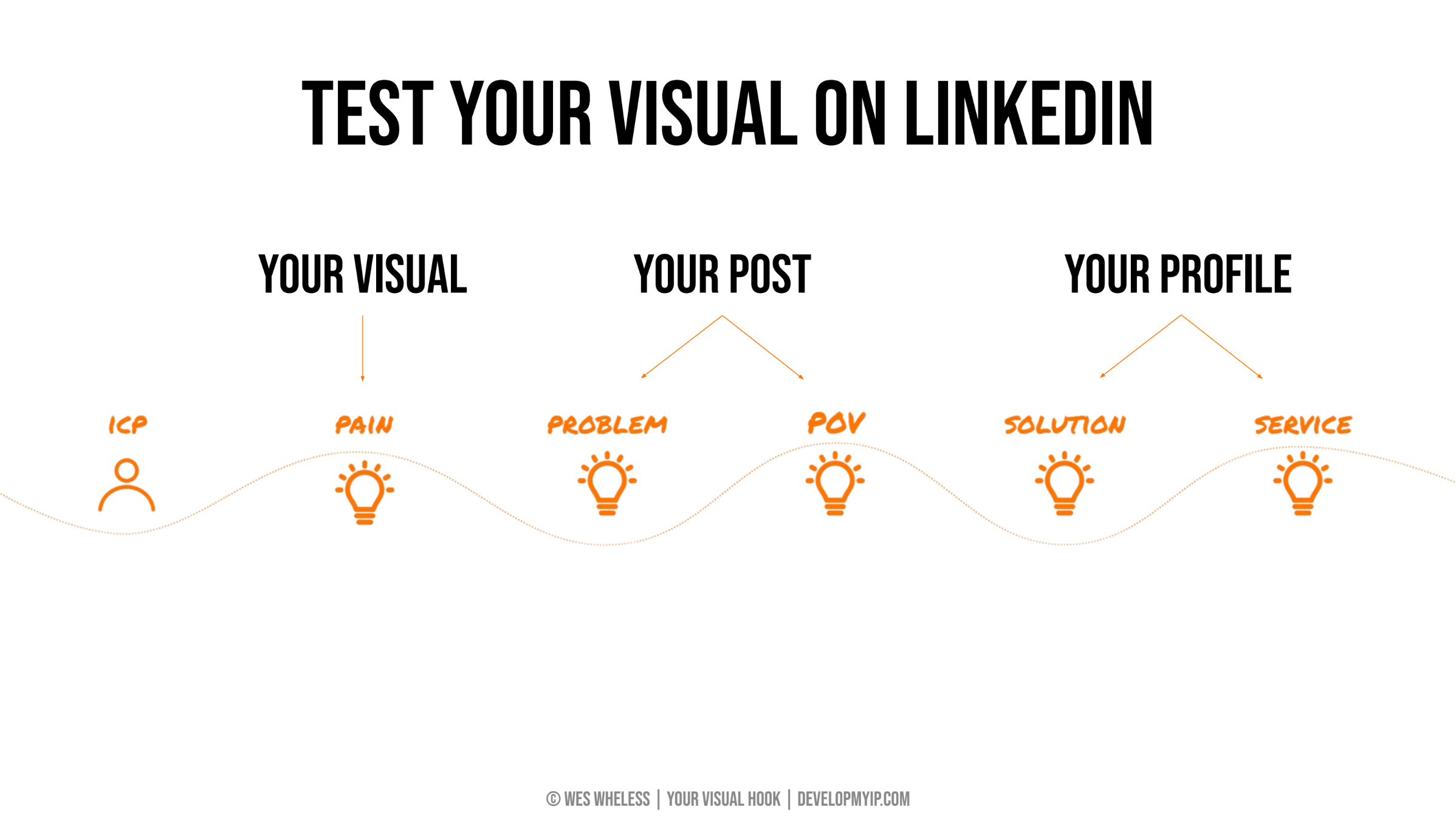
Keep the pitch out of the post. Wes’s sample post for the climate tech CEO describes the regulation change that washes next year’s strategy away, then argues the company has grown too big to keep building sandcastles. It never makes an offer.
Test several image variations. When one makes people’s eyes light up, you know that’s your signature visual. Then put it everywhere your buyers will see it. Wes’s clients use theirs in their LinkedIn Featured sections, to open talks, in their email signatures, and on their websites.
How to know you’ve got the right pain
During the Q&A, someone asked how you know you’ve landed on the right pain before you build everything around it. Wes’s answer is to stop guessing.
Get it from your clients’ own words instead:
Discovery conversations: Ask prospects why they reached out and what they can’t solve themselves. Then ask what’s at stake for them personally.
Past clients: Ask former clients to describe where they were when they first came to you. Record the call so you get their exact words, then use their language or name the feeling underneath it.
Build one image first, then a family
Once your hook image is working, build visuals for the other parts of the narrative spine. You can keep the same motif or mix metaphors, as long as they tell one story.
Wes built a full set for a culture consultant who helps CEOs push new strategies through the org. One visual makes a point buyers don’t expect. When an org stalls, everyone blames the front line, but the hold-up usually sits with middle managers. That single image has become her main talking point on sales calls.
The next level is before and after
Wes closed with a challenge. Find one metaphor that shows both the pain and the fix.
The growth coach’s after image turns the traffic cop’s intersection into a roundabout, with the CEO standing off to the side while an accountability system keeps the cars moving. A fractional CMO shows a scattered flock of birds, then the same flock in formation after her messaging guide.
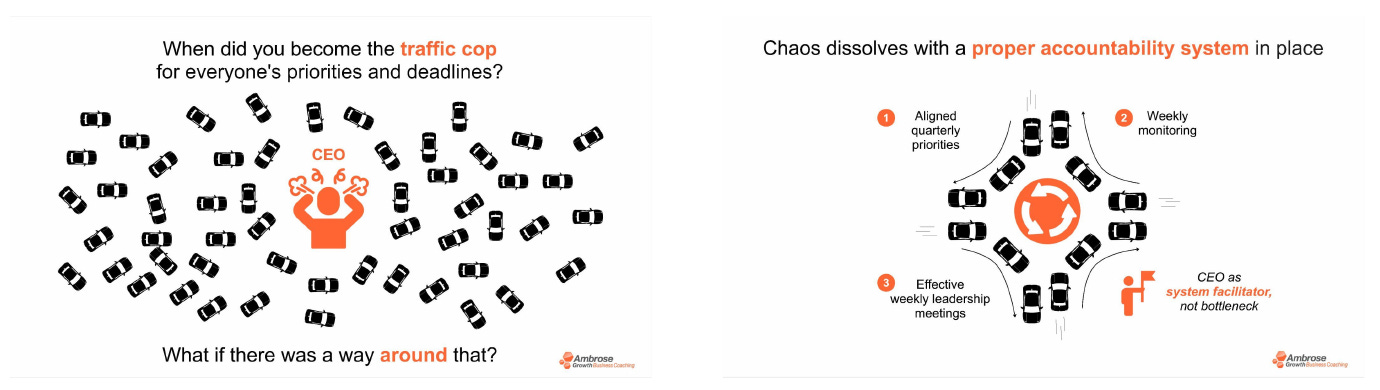
You meet the buyer in the pain and show them the way out in the next image.
Putting it together
Block 20 minutes this week and work through these four steps.
Write down a description of your buyer and the human pain they feel.
Paste Wes’s prompt into ChatGPT with your buyer and their pain filled in, and pick the metaphor that best carries that feeling.
Ask ChatGPT to create an image of that metaphor, and ask for a pencil sketch if it looks too AI.
Post it on LinkedIn with a few lines about their problem and how you see it, and keep testing until one resonates.
Once one lands, build images for the rest of the narrative spine.
Most solos are still standing at an empty stand, talking. One good image puts your strawberries on the table.
Keep building,
Garrett
Just for 10x Solo members:
The recording from Wes Wheless’s Visual Hook workshop is up in the Notion library, along with the Google Doc holding his slides and the ChatGPT prompt that generates ten visual metaphors for your buyer’s pain.
This Thursday’s workshop: Casey Silveria, a fee-only fiduciary wealth advisor, on building a capital allocation policy for lumpy income. You’ll leave with a simple written order of operations for money as it lands, not another budget to ignore. 10am PT / 1pm ET, an hour later than usual, and already on your calendar.
In #asks-and-answers: I asked why outreach is so hard to stay consistent with, and gave seven answers to pick from. 20 replies so far, and it’s still open if you want to add yours.
P.S. Want more from Wes?
The Expert’s Privilege: His book. DM him on LinkedIn for free copies of chapters 11 and 12, on extracting your IP and making it visual.
The Lightbulb: His newsletter on positioning and visual IP for solo consultants.
Intellectual Headshots: His visualization service. It starts with a free fit call.
All his links are at weswheless.com.
P.P.S. When you’re ready, here are two ways I can help you:
Join the 10x Solo community: A private community of full-time B2B solos, fractionals, and small agency owners. Weekly workshops, honest peer feedback, and referrals. Apply here.
Work with me 1:1: For maxed-out consultants, fractionals, and agency owners who want to make more money in less time by refining their business model, offers, and systems. A few spots open at a time. DM me to set up a time to chat.
Have questions or comments about today’s topic? Share them below. 👇