

A consultant I work with said something a couple of weeks ago that I haven’t been able to stop thinking about.
We were talking about effective hourly rate. He said, “I talk about that with my clients but I never think about it for myself.”
If you’ve never run it either, here’s what it is:
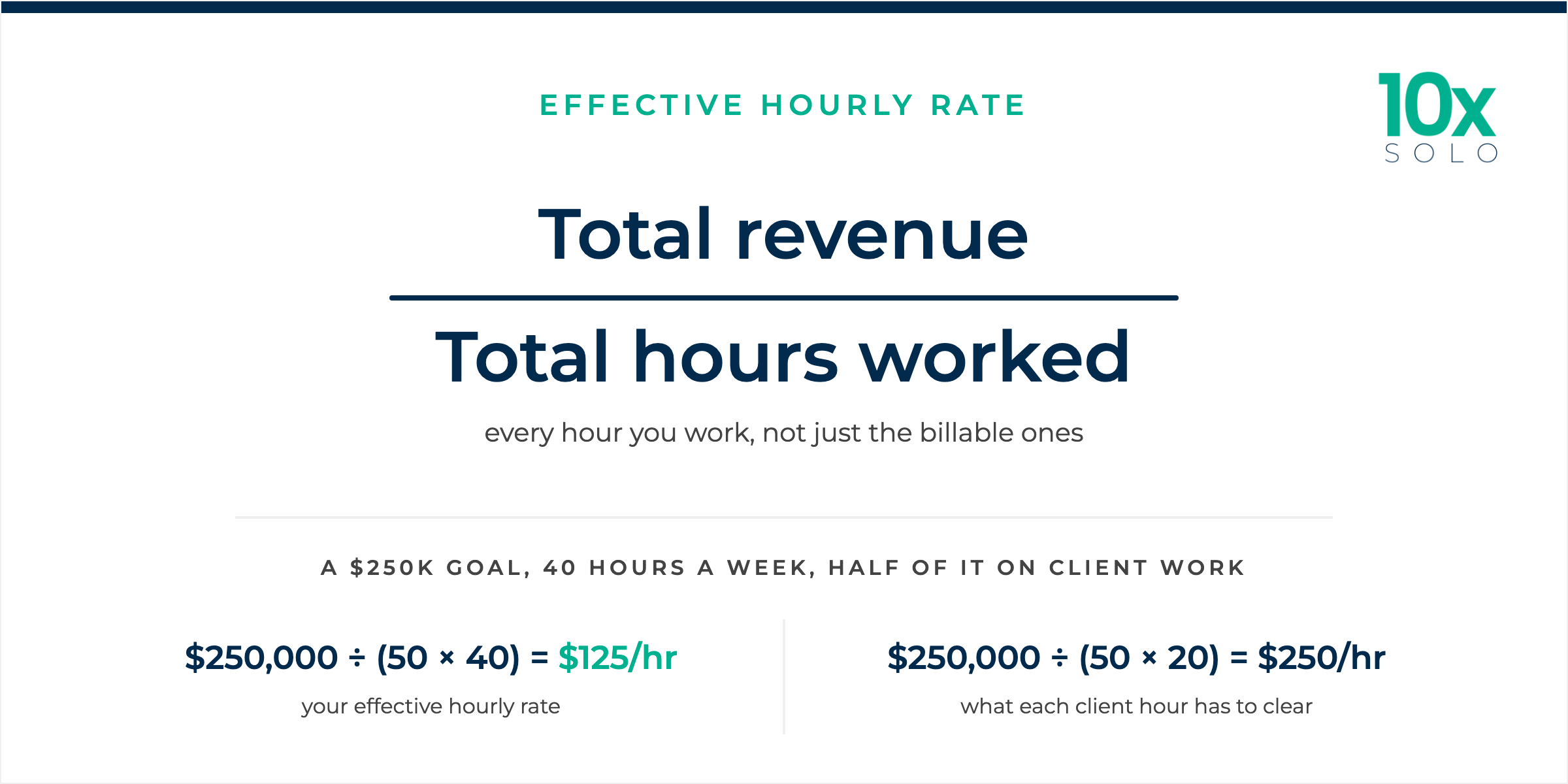
Effective hourly rate = total revenue ÷ total hours worked
Total hours means every hour you work, including the ones you can’t bill for directly. That includes time spent on marketing, sales, proposals, admin, and everything else it takes to run your own business. Nobody pays you for those hours. For many solos that can add up to 15-20 hours in a 40 hour week.
To be clear: I never recommend charging hourly. But it’s still important to know where your hours go each week.
Nearly everyone I’ve met who went solo wanted some version of the same thing: to make more money working fewer hours. Some care more about the money. Some care more about the hours.
Most of us track revenue closely. Far fewer of us know exactly where our time goes each week. That’s a problem, because revenue only tracks half of the goal. Effective hourly rate is the one number that tracks both.
It’s also how you connect your annual goal to your week. Many solos set a revenue goal for the year and never translate it into what each hour needs to earn. When I went solo my goal was to work no more than 40 hours a week and at least replace my salary.
Let’s say your version of that is that you want to make $250K a year, working 40 hours a week, with 2 weeks off. Assume only half your time can be spent on client work, and the rest is spent running your business. That’s 20 billable hours a week.
$250,000 ÷ (50 weeks × 20 hours) = $250 an hour
That means, if you’re fully booked with clients, you need to average $250 an hour across all client work or you won’t hit your annual revenue goal. Your effective hourly rate across all 40 hours would be $125. Same business, same money. The $250 is the bar each client hour has to clear to pay for the 20 hours nobody pays you for.
(Yes, I realize revenue is not take-home pay. Taxes and expenses still need to come out of this. But let’s ignore that for now.)
So run the math both ways. Per client, using only the hours you spent on that client, to see which engagements are pulling you up or down. That's the number that has to clear $250. And across your whole business, using all your hours, to see if you're hitting the goal.
Here’s what this looks like in practice from two examples from recent client calls:
First, a consultant I work with had just billed over $30K for the third month in a row. Almost in the same breath, he said, "I'm already spending so much time. I'm kind of at like $120 an hour the way I'm running." At his revenue, that meant a lot more than 40 hours a week. He was happy about the revenue, but he was working more hours than he wanted and it wasn't sustainable.
Second, with another consultant that same week I was auditing her current clients. Together we calculated her effective hourly rate per client: $162, $87, $300, $126, $200. It was a bit all over the place.Some clients were paying her nearly four times more per hour than others. She had no idea until we did the math.
So how do you fix this? It starts by tracking your time. Here’s how I do it:
I use Rize.io to automatically log where my time is spent while I work. It runs in the background so I don’t have to remember to hit start and stop on an annoying timer for each client (hard to do when you are ADHD and multitask as much as I do). (Full disclosure: I advise Rize, but am also a big fan of the tool.)
Every Friday I have Claude read that data and calculate my effective hourly rate for the week, both overall and by client.
When a client comes in well under the others, it's usually because I did too much work for them that week, so I balance it out the next. The overall number tells me whether I'm on track for the year.
You don’t need any special tools to get started.
Take last month’s revenue by client
Divide each by the hours you worked for that client
It only takes a few minutes, but it will show you which clients are helping you hit your goal and which engagements need to be rescoped or repriced.
It’s okay to estimate your hours per client if you’re just getting started. Look back at your calendar from the last few weeks to get a rough idea. But eventually, it gets more accurate once you start tracking your time.
Once you know your number, there are four ways to improve it:
Raise your prices
Reduce the hours it takes to deliver each engagement
Reduce the hours you spend running your business
Change the types of clients you work with
The consultant I mentioned above is trying to improve his number by offboarding himself from his smallest account and building an offer he can charge a premium for. He didn’t need more clients yet. He needed to work fewer hours without giving up the revenue.
Your invitation for the week: Take 10 minutes to figure out your effective hourly rate for last month. If it’s below what you need to hit your annual goal, pick one of the four levers above and make one change to it this month.
Know your effective hourly rate. It’s the only number that tells you whether you’re making more money in fewer hours, or just more money.
Keep building,
Garrett
Just for 10x Solo members:
Last Thursday’s workshop: Samantha Prestidge on when to hire a VA, and who that person should actually be. Her most contrarian point is that waiting until your SOPs are written means waiting forever, because at capacity you never find time to document anything. Recording is posted in the Notion library.
This Thursday: Speed Networking + Group Discussion at 11am MT. We’ll connect in small breakouts and discuss the question, “What’s working in your pipeline right now?” Already on your calendar.
In #asks-and-answers: “I would typically charge $250/hr but they are based in Europe. Anyone have insight into pricing European companies?” 6 replies
P.S. When you’re ready, here are two ways I can help you:
Join the 10x Solo community. A private community of full-time B2B solos, fractionals, and small agency owners. Weekly workshops, honest peer feedback, and referrals. Apply here.
Work with me 1:1. For maxed-out consultants, fractionals, and agency owners who want to make more money in less time by refining their business model, offers, and GTM systems. I just wrapped up with a client and have one spot open. DM me to set up a time to chat.
Have questions or comments about today’s topic? Share them below. 👇
The per-client version of this number is where scope creep shows up in the math. A client can look fine on revenue and still sit far below the others on effective rate, because unscoped extras land in their column. Running it per client turns "this one feels like more work" into a number you can re-quote from.
I love this conversation. I think it's really important for anyone going out on their own. Another consideration, I know this is a solo business, but knowing that rate helps you understand what you should delegate to someone else as well.
So if your rate is $250/hr and you can hire someone (or contract someone) for $150/hr that could be a good investment to spend more of the time in the right place.
I also understand that might defeat the purpose of the solo business. 😂
Thanks for sharing, this was really helpful.